RACE PACE ANALYSIS:
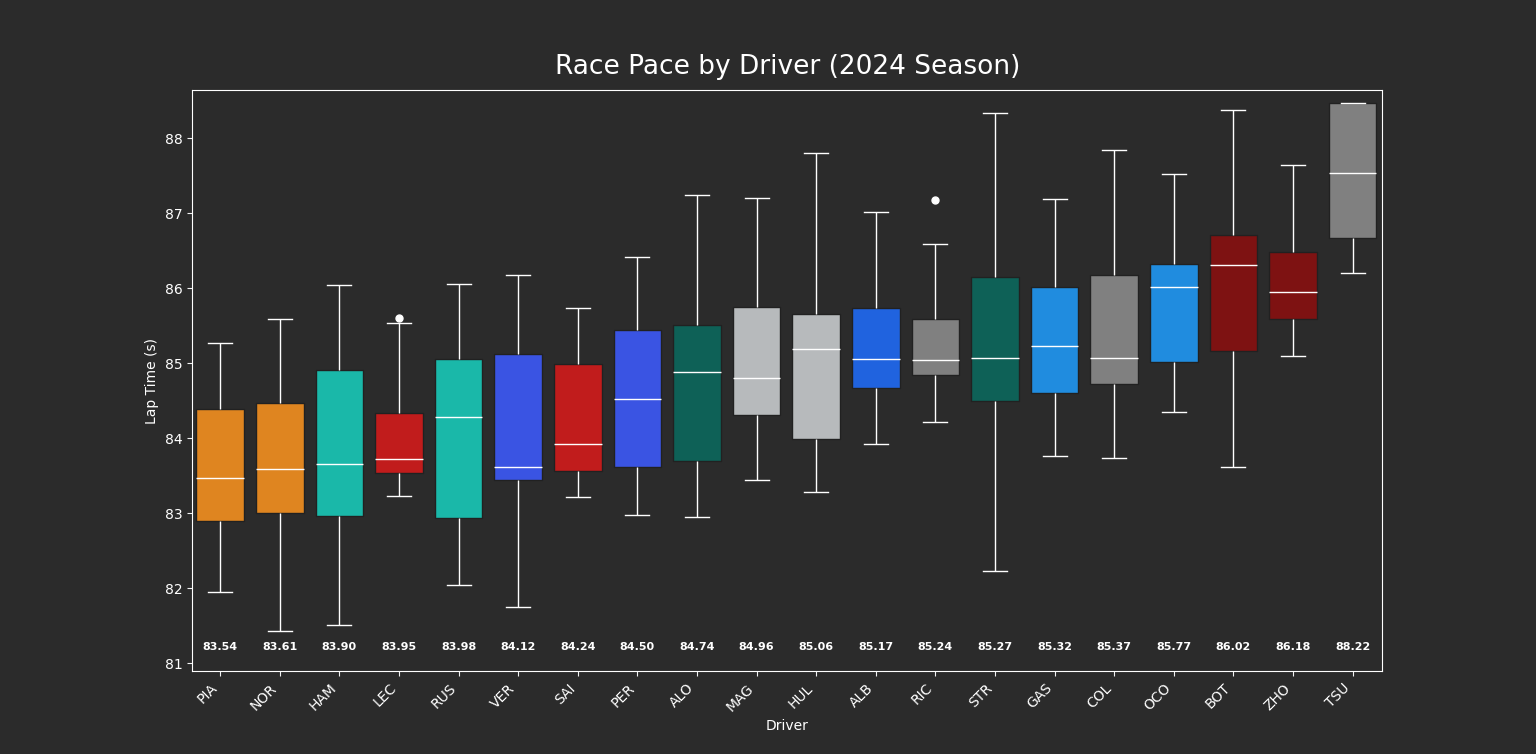
On race pace, the performance of McLaren is indisputable, especially of Piastri who is faster than his teammate by 0.07 s/lap. McLaren gave a good beating to Mercedes, Hamilton lost 0.36 s/lap on Piastri and 0.29 on Norris. In difficulty the Red Bull losing to the main rival about 6 tenths per lap.
To compliment also the great step of Ferrari, considering that they made 2 stint unlike the other teams who have bet on 3 stint for fear of the phenomenon of graining. Leclerc lost only 0.05 s/lap compared to Hamilton and Sainz only 0.12 s/lap compared to Verstappen and was the fastest by 0.26 s/lap compared to Perez.
We can not but highlight the great constancy of Leclerc, which was particularly in the second stint.
To be rewarded also the performance of Williams, who managed to qualify in points with Albon and rookie Colapinto in P12, who had a very similar step to the two Alpine, and lost "only" 0.2 s/lap from teammate.
Let’s make a more in-depth analysis by observing the race pace in certain stint.
STINT 1 ANALYSIS:
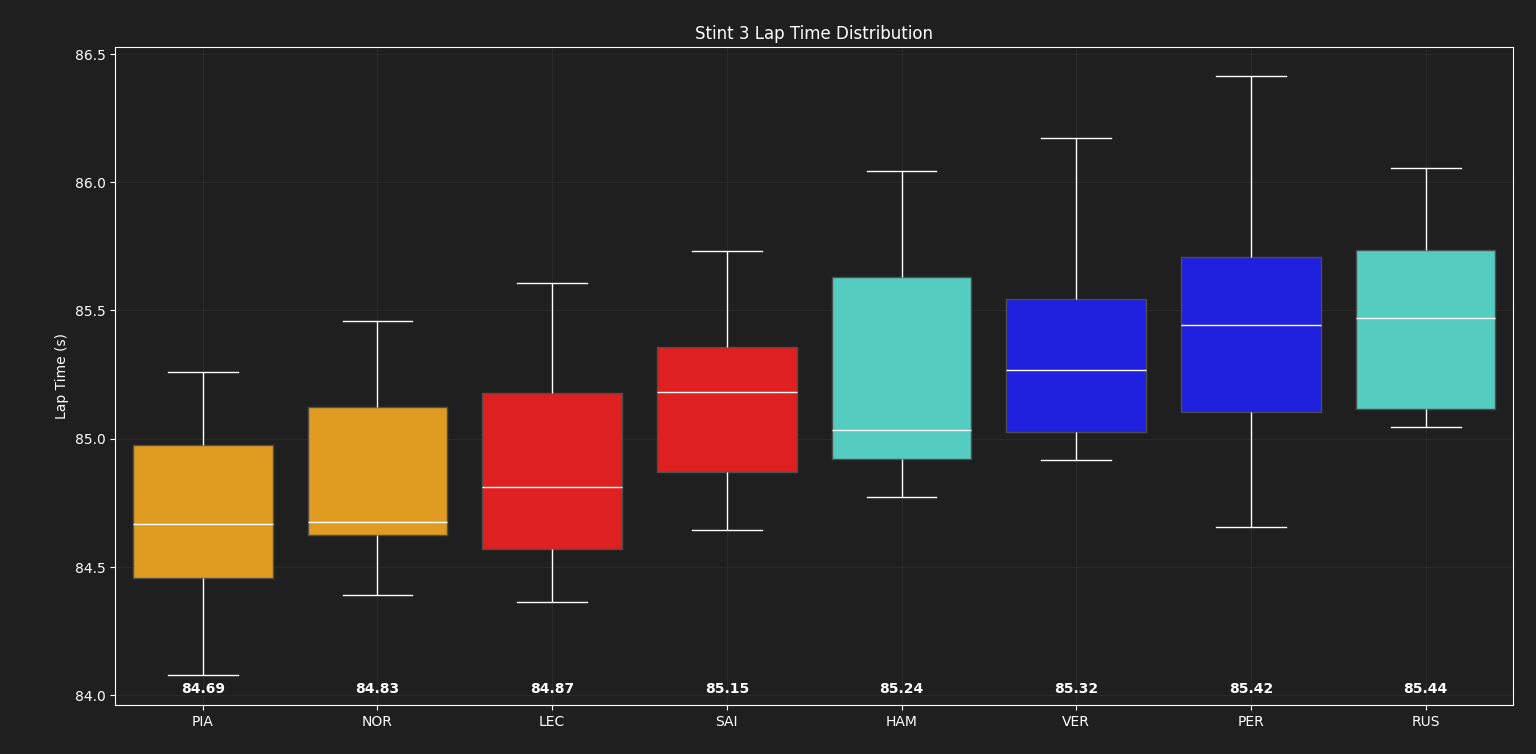
A magical first stint for Piastri who, with the same performance, overtakes Norris at turn 4, as Hamilton did on Vettel in 2018, only for the German driver to spin around while the British rider with number 4 manages to control it. Not only for this reason Piastri had a great first stint, but also considering the performance in the following laps, faster than his teammate by 0.14 s/ lap and 0.18 s/ lap on Leclerc, was also excellent management of tires, In the first stint, it was the best to manage the phenomenon of graining.
Talking about Norris, compared to his comrade Piastri was more subject to the front-end wear, confirmed by the fact that the team suggests Lando not to deal very quickly with several curves to reduce wear, but it doesn’t seem to have much influence on Norris’s pace, which although slightly slower than his teammate was among the most consistent. McLaren with the #4 is among the first to enter, mainly to try an undercut on the Monegasque who will then win the race, a strategy that works at the moment.
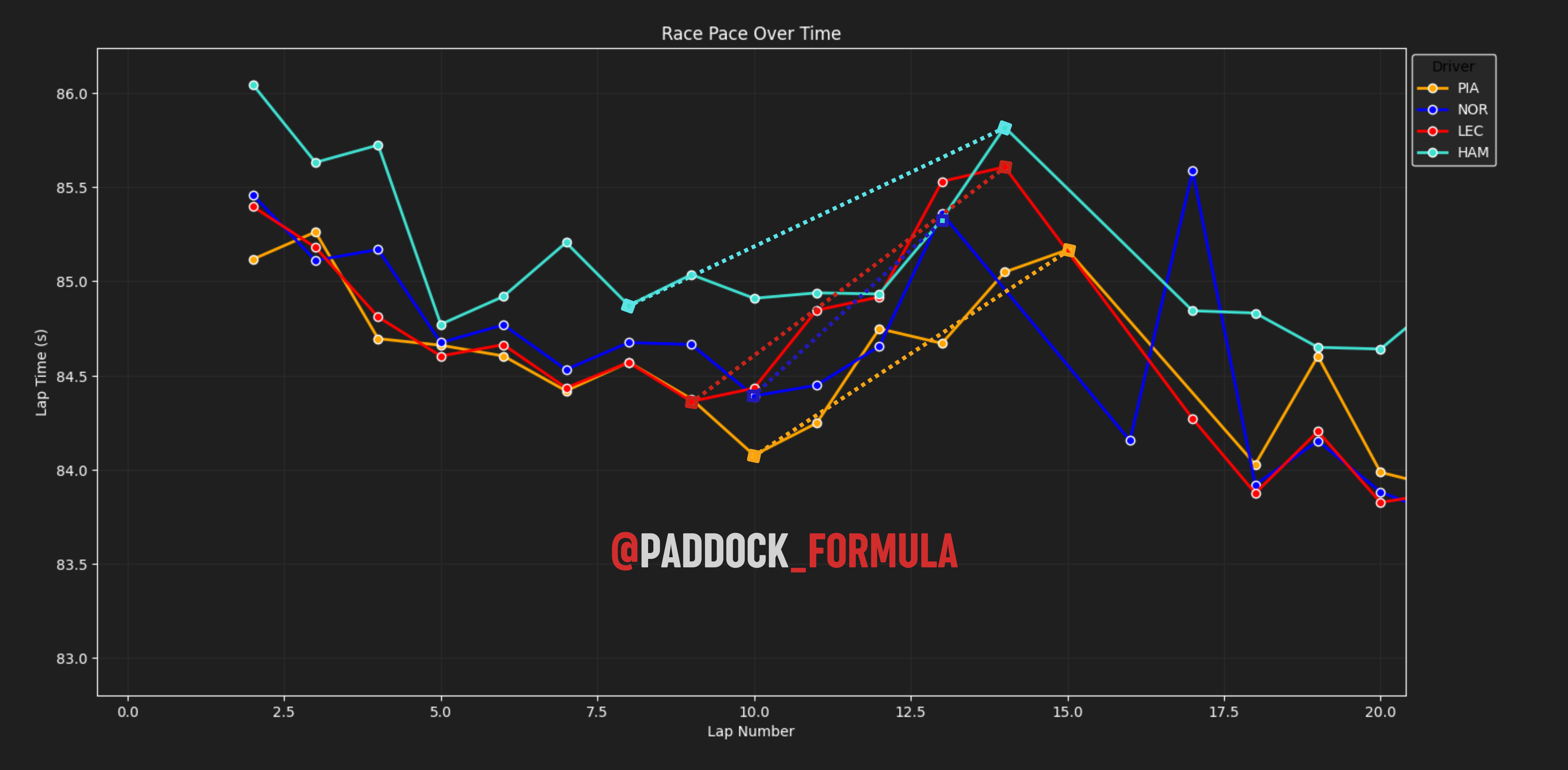
Leclerc took advantage of the overtaking of Piastri on Norris to take the second position, for several laps he managed to stay in the DRS zone but after the ninth lap the wear and graining are felt, losing about 0.4s/lap compared to previous times. So they decide to pit to neutralize the undercut of Norris, but it does not work. The race already seemed lost.
For Sainz the strategy is a little different from the other drivers who have used medium tyres, in fact he extends the stint until the 20 lap, unlike Hamilton who stopped 4 laps earlier, despite this Hamilton loses in the first stint 0,4 s/lap compared to the Spanish of Ferrari. A very difficult stint for Lewis, the Mercedes was hit by a high phenomenon of graining, increasing wear and reducing grip, in fact complaining about the stability of the car in turns 6,7 and 11. Not only are these the problems for the British, there were also problems of balance of front brakes and understeer.
He’s not better off even his teammate, George Russell, who for an error in turn 1 on the first lap, breaks the endplate of his front wing, forcing him to a pit very early, on lap 12, to replace the front wing.
The two of Red Bull instead started the race with a different compound, start with hard, probably their strategy was to finish the race with only one stop and take advantage of the fastest tire in the final stint. But the high track temperatures and the poor grip of the circuit at the start of the race have hampered the plans of Red Bull, where already on the fifteenth lap they begin to show a wear and graining quite important that causes the increase in times in the two RB20.
STINT 2 ANALYSIS:
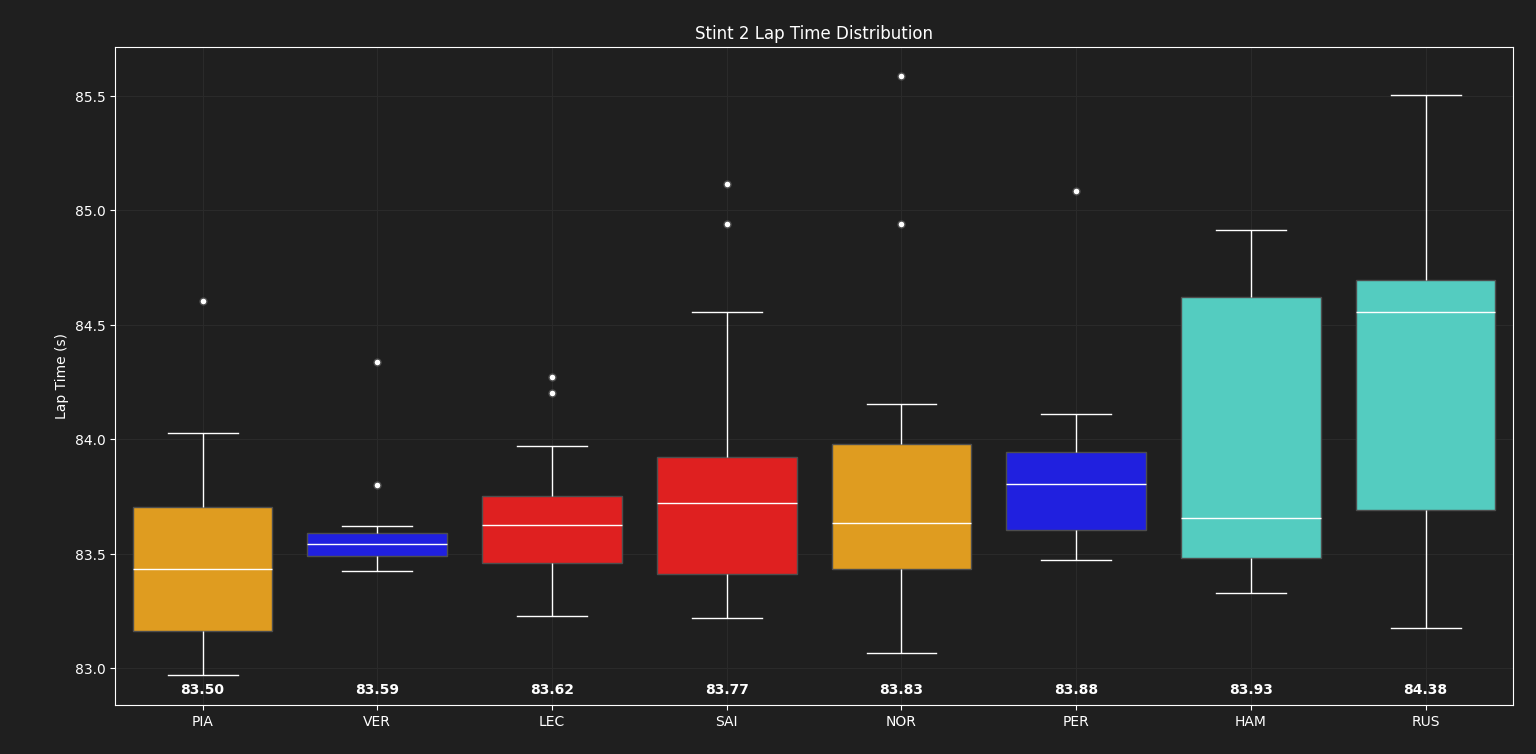
Verstappen’s consistency with the new set of hard is immediately noticeable, and it is only 0.09 s/ lap slower than the Australian McLaren, who again records the best pace, but you have to consider some things, that Max has newer tyres and only makes 18L unlike Piastri with 20L.
But it is necessary to emphasize the constancy of Leclerc for 40L , loses only 0,12 s/lap compared to Piastri who made only 20L.
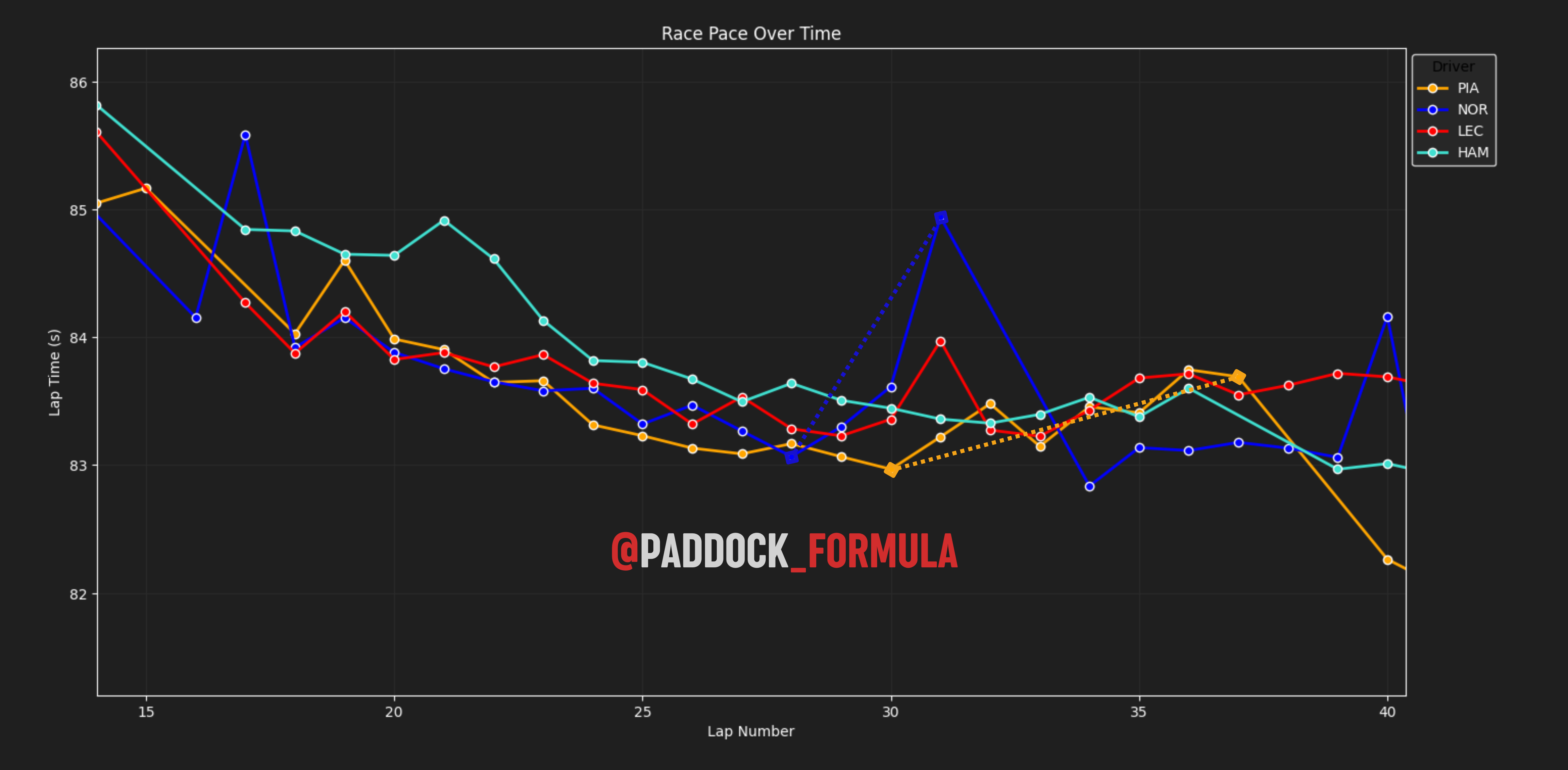
Plan C of the Ferrari apparently referred to manage the tire and go until the end, making only one pit-stop. Management that does not happen in the McLaren team, which instead focus on plan B, especially Lando Norris is hit towards the end of the stint by a high degradation of the tyres, specifically the front left (support wheel in turn 11), while Piastri the degradation is less accentuated and maybe he could have stayed on those tires and not waste time for the 2nd pit-stop.
Lando Norris suffered a lot in the second stint, losing 0.23 s/lap compared to his teammate, unlike the 0.14 s/lap lost in the first stint.
But the concern for a graining accentuated towards the end made that the two McLaren aimed at plan B and stop to mount new hard.
Hamilton does not seem to have had a high degradation, indeed the trend of times in the second stint has a decreasing tendency, but the team via radio communications says to make a pit stop opposite to Sainz, therefore aiming at two stops, mounting a new set of hard.
Both Mercedes are not doing well in this stint, showing a clear difficulty with the stability of the car and lack of grip. Hamilton’s main opponent should have been Sainz, but compared to him Lewis loses 0.31 s/lap. (Considering always Sainz has 33L while the British 21L)
STINT 3 ANALYSIS:
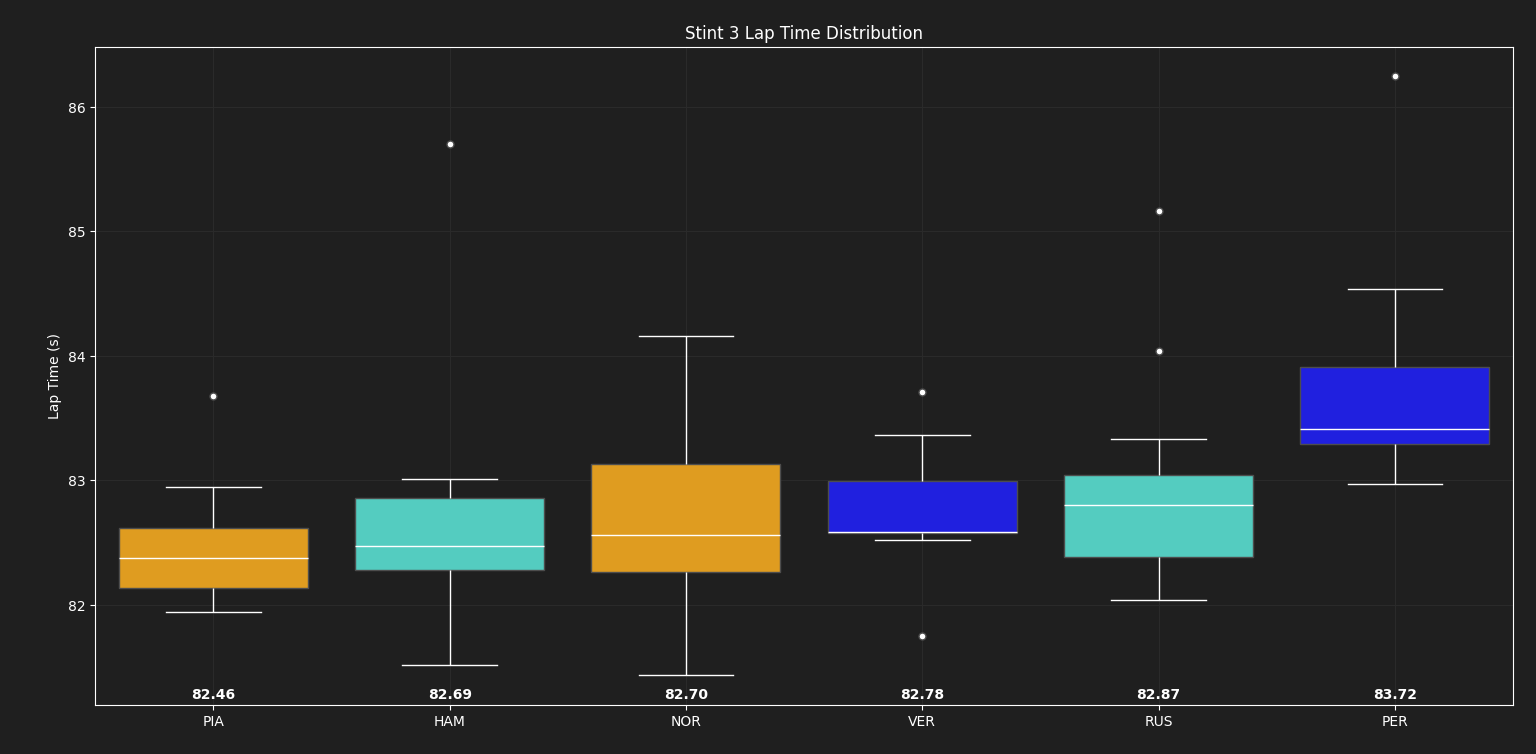
Better instead the Mercedes of Hamilton, which records a lead of 0.01 s/lap compared to Norris, a minimal advantage, but has reduced losses per laps at least compared to a McLaren. Woking’s car with the number 81 is also the fastest in the third sector.
Piastri after the second pit at minus 15L at the end of the race rides again hard, and gave everything in recovering the two Ferraris. He manages to recover that of Sainz, even if it gives him some headaches that favor the monegasque. But at the end of the race he is in second place, not being able to pass even the second Ferrari.
Today’s performance by Ferrari indicates that the problems in previous races have disappeared, and is again fighting for the constructors' championship, and at Monza it was the second force.
Back to the race, also Norris manages to recover one of the two Ferraris, getting the second place, but he was not as good as his compatriot, increasing the time lost in the lap to 0.24 s/ lap (similar to the previous). But it shows how the car of Lando suffered in particular from the wear of the front left tyre.
TURN 11 - 6 - 7 ANALYSIS:
We also analyze how they faced the parabolic, one of the curves that put more stress on the wheels, especially the front left, or that gave so many problems to Norris:
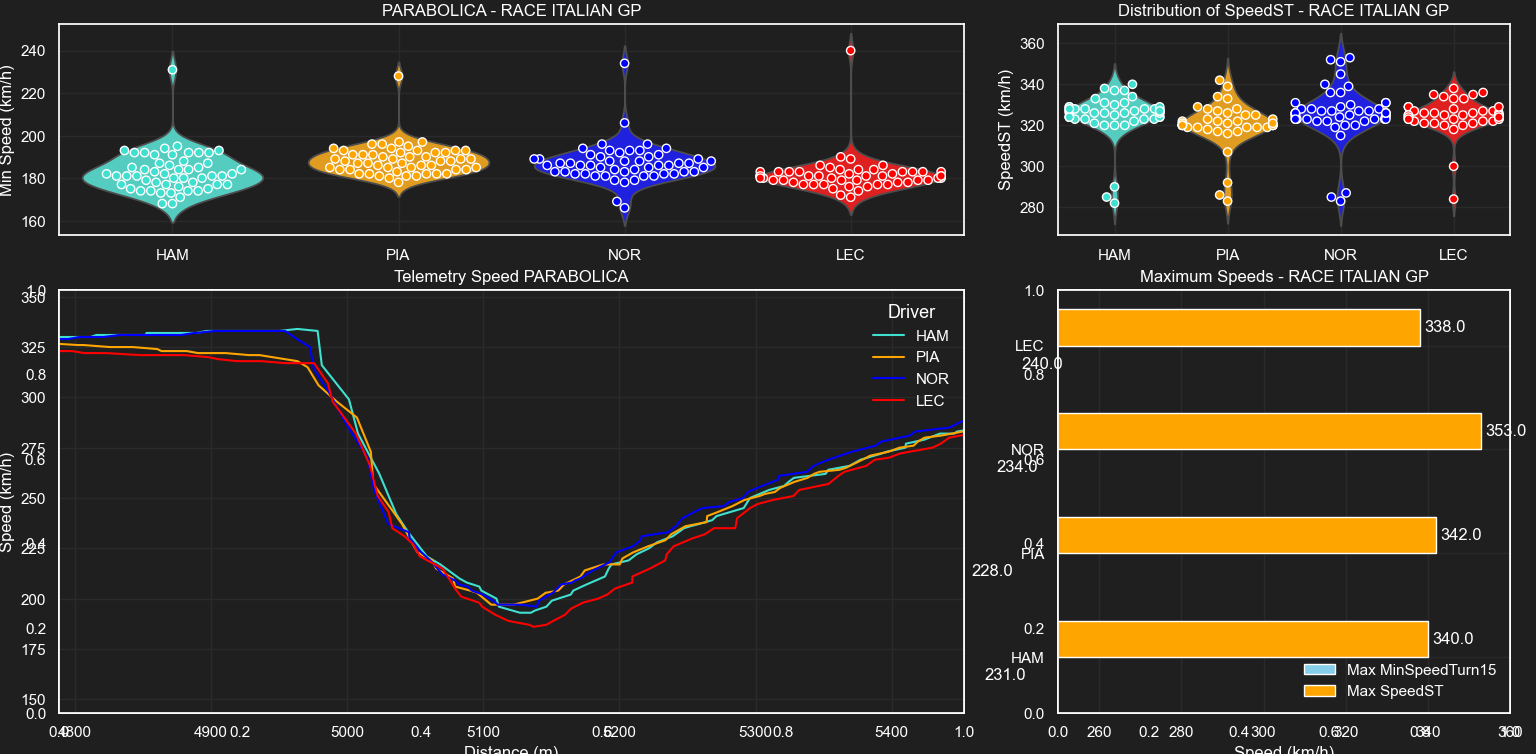
Obviously it is not the only curve to stress the curves, but also the 6 and 7, but the others we will see later:
Between Piastri and Norris the difference is not much, but entering in the smallest details Piastri is more constant, presenting a curve of diffusion at km/h greater than that of his teammate, who somehow had to manage the front left tire.
Leclerc faces the parabolic with a really lower speed than its rivals, and there are two reasons: a configuration more drained than McLaren and Hamilton’s Mercedes, but also to manage better tyres and get to the end of the race with hard tires.
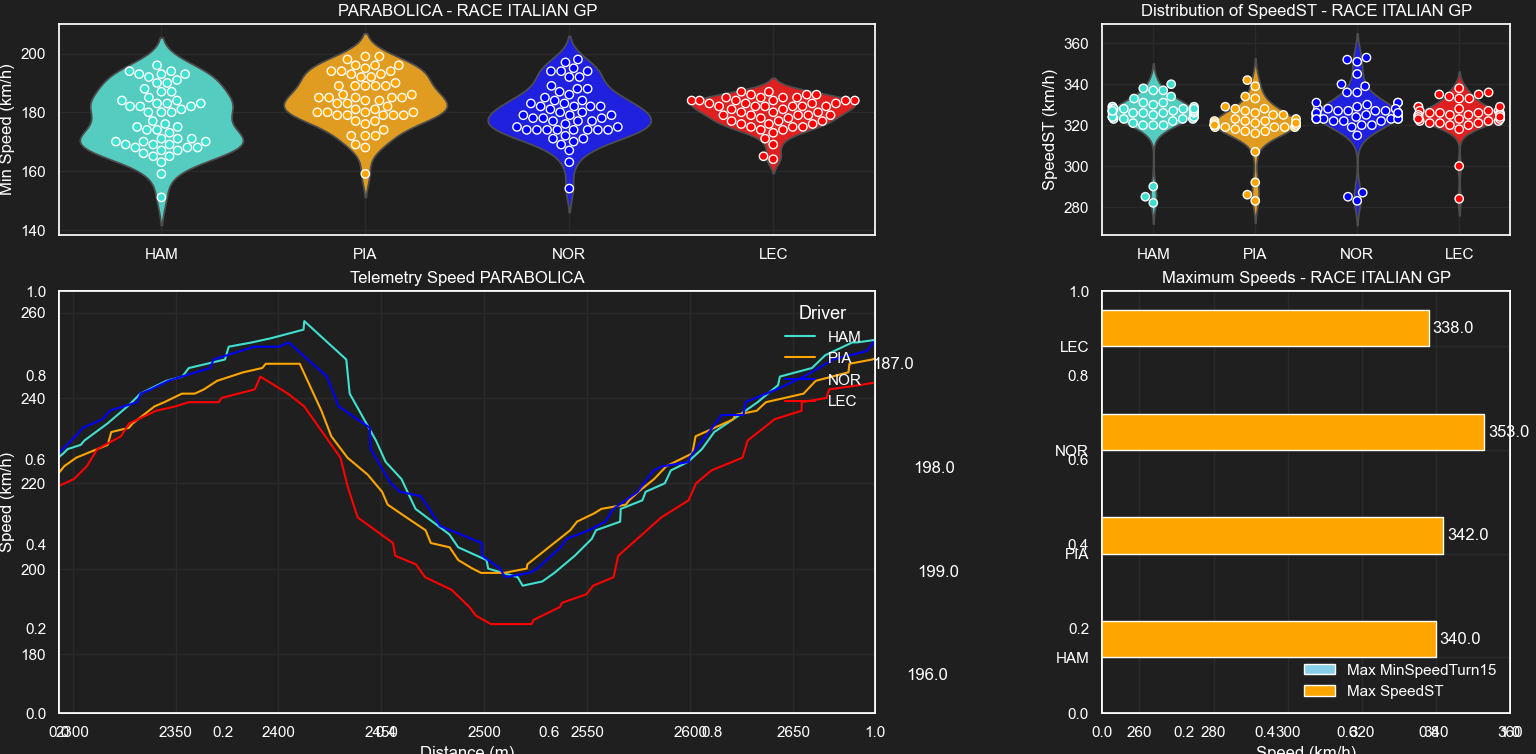 Even if it is written parabolic the curve is Lesmo 1 (I misplaced the title, sorry).
We can notice that Leclerc is the most constant, and it faces the curve on average to 180 km/h, while the others have values diffused in a less constant way, but their peak of curve of density is to km/h smaller than that of the driver Ferrari.
The peak of density curve of Norris is at km/h lower than that of Piastri, a probable signal that also here tried to manage the front left. The same can be said for Hamilton.
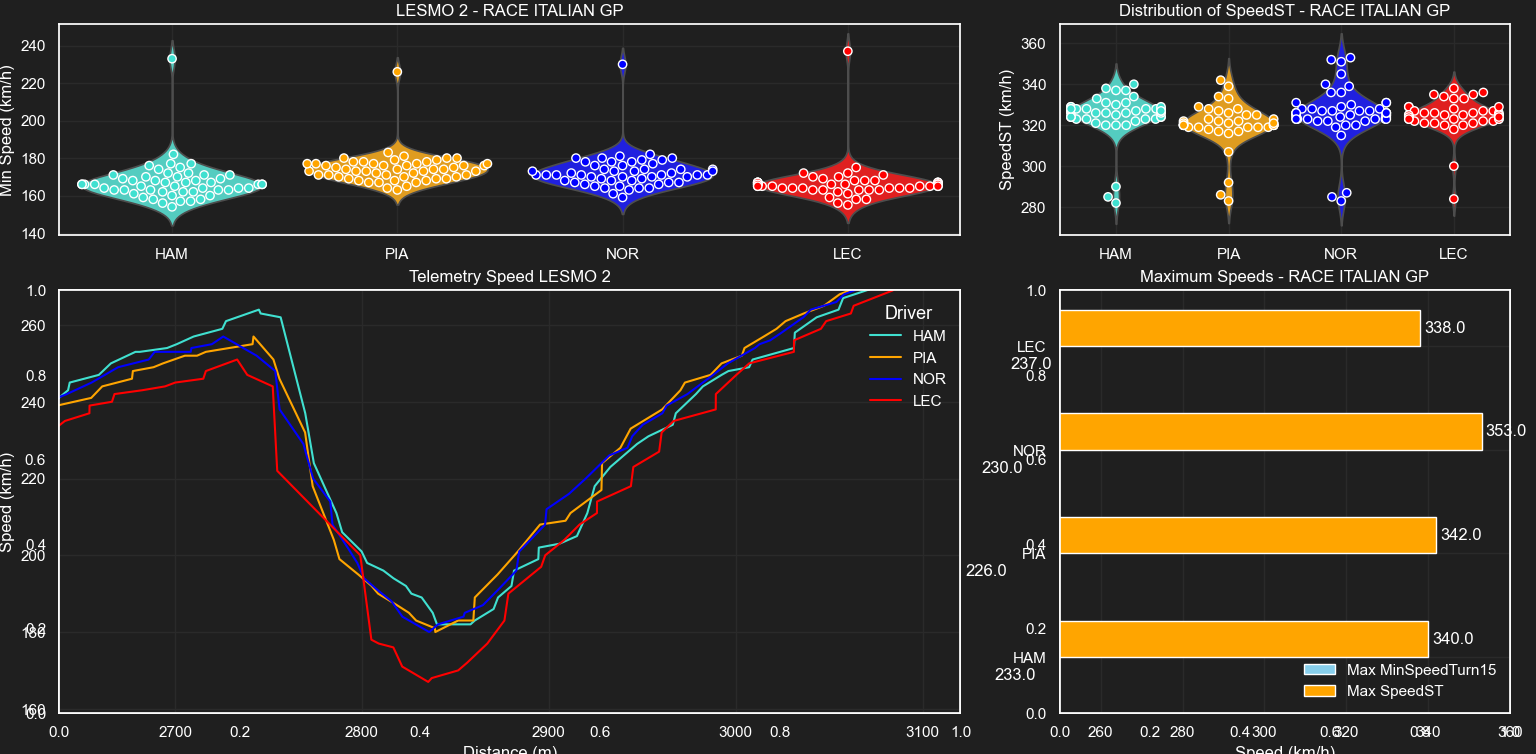
Always talking in detail, as in turn 11, Piastri has the peak of curve density greater than Norris superior. While in this case Leclerc and Hamilton have a similar and lower peak to McLarem, however, #44 is slightly less constant than #16.
Commenti
Posta un commento