In FP3, also because of the two red flags, the teams decided to focus on the simulation of qualifying, let’s analyze the fastest lap of the first three of the last practice session.
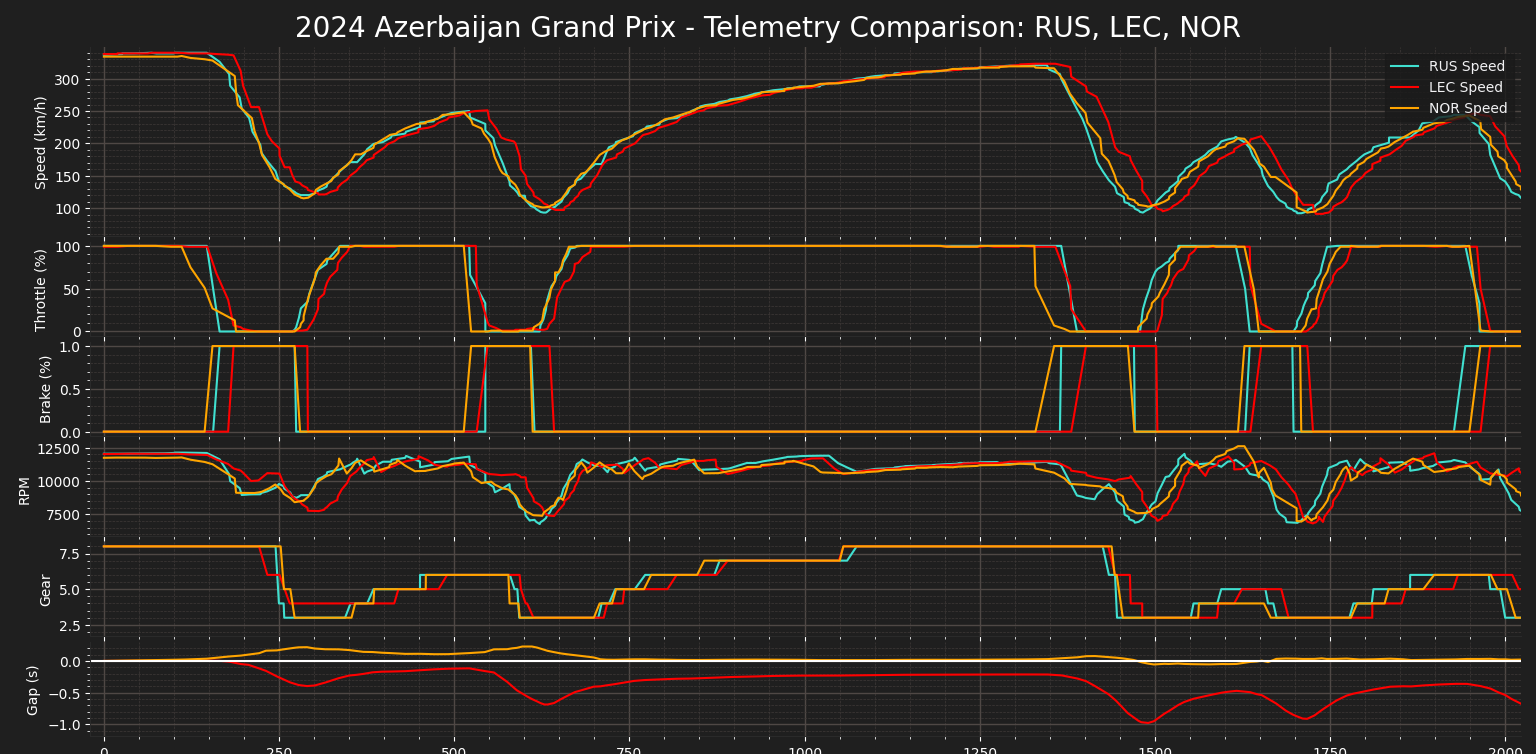
As in FP2, the Ferrari decides to optimize the speed in input compared to the exit, perhaps this choice was thought by the fact that the suspension scheme of the SF24 fails to give the best traction and prefers to use the ERS to optimize the EOSS.
Norris’s McLaren and that of Russell have a similar trend, in turn 1, Norris slows progressively and brakes earlier, but the W15 of the British has still slightly better exit, and this makes lose some time to Lando. Meanwhile, Leclerc takes the turn in IV gear.
Leclerc is the one who comes out with an advantage, and he is preparing to tackle turn 2 in a similar way, delaying the break-off, bringing more speed into the entry, much more decided then with the scaling of the gears.
It should be noted that in turn 3, compared to last year and FP3, it no longer tends to brake twice. After the third turn, the driver of Mercedes and Ferrari move to IV, while Norris remains on III, taking advantage of the high rpm, and brings more speed in entry. The best traction at the end is Russell who heads to turns 5 and 6, where he finishes the first sector.
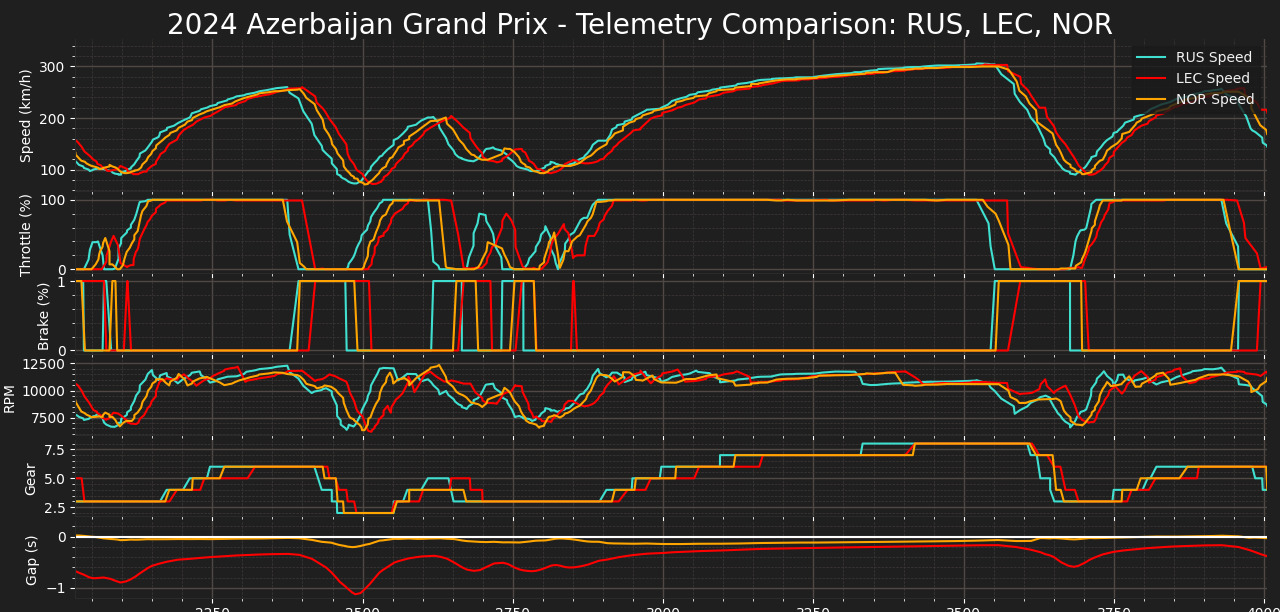
In the second sector it is more evident how they tend to tackle the curves, Russell favors the traction on the exit, McLaren tends to aim for a compromise while Leclerc instead optimizes the speed on the entry. We therefore have three different ways of dealing with T2.
Unlike Perez in FP2, here the three drivers between corners 5 and 6 use the brake again. We arrive at turn 7, Russell arrives at 257 km/h, Norris 253 and Leclerc 258.
We go directly to turn 12, where we notice that Leclerc is the only one to brake, while Piastri and Norris can tackle it without having to brake. When Charles reaches 100% throttle the speed difference is: 216 km/h for Russell, 211 for Norris, while the n°16 only 199 km/h, a difference of 17 km/h on George and 12 compared to Lando.
This is a point where Leclerc loses a lot in the exit phase, but also after the exit of turn 7, the same goes for George, who sees that the gap from Norris increases.
We then arrive at turn 15, with a speed of 306 km/h for Russell, 303 km/h for the Monegasque and 300 km/h for the McLaren n° 4. In fact, we notice that the W15 number 63 goes to the VIII gear much earlier than the two rivals.
Following the curve 15, in traction phase Russell manages to reduce the gap compared to Norris and also compared to Leclerc who meanwhile had gained a lot in the entry phase.
Going towards turn 16, we enter T3.
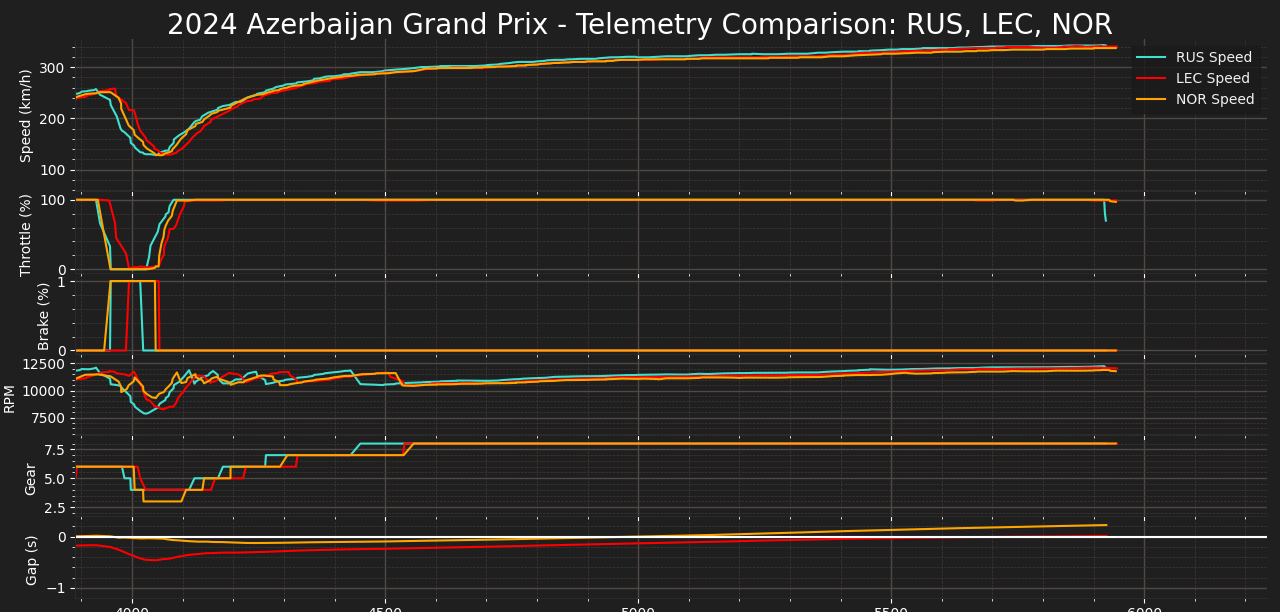
Here too we confirm the choice of Leclerc to favor the speed of entry, which however goes at the expense of the speed in exit. Charles is also the only one of these three to face it with a gear major.
Russell as we have seen optimizes the speed in exit, in fact when the Monegasque reaches 100% of the throttle, George has a speed of 225 km/h, Norris of 221 while the number 16 of 208 km/h.
In the long final straight, the number 63 manages to increase the gap compared to Norris, while it manages to reduce and create a very small advantage even compared to Leclerc, only 20 thousandths.
If you like my content follow me here (it’s free) and also on the other social networks, while if you want to support my project, I would be very happy, but don’t feel obliged to do so!
Commenti
Posta un commento