The FP2 are termite, the first day of the weekend in Baku is over and let’s go to analyze the FP2 together!
CONDITIONS:
Track temperature: initial 36,8°C, end 32,9°C
Air temperature: initial 28,7 °C, end 27,5°C
Humidity: initial 28%, end 47%
Wind: 2,2 km/h
LONG RUNS ANALYSIS:
Unlike FP1, all teams focused on the simulation of the race step, some, like Russell and Norris who preferred to focus their attention on long runs.
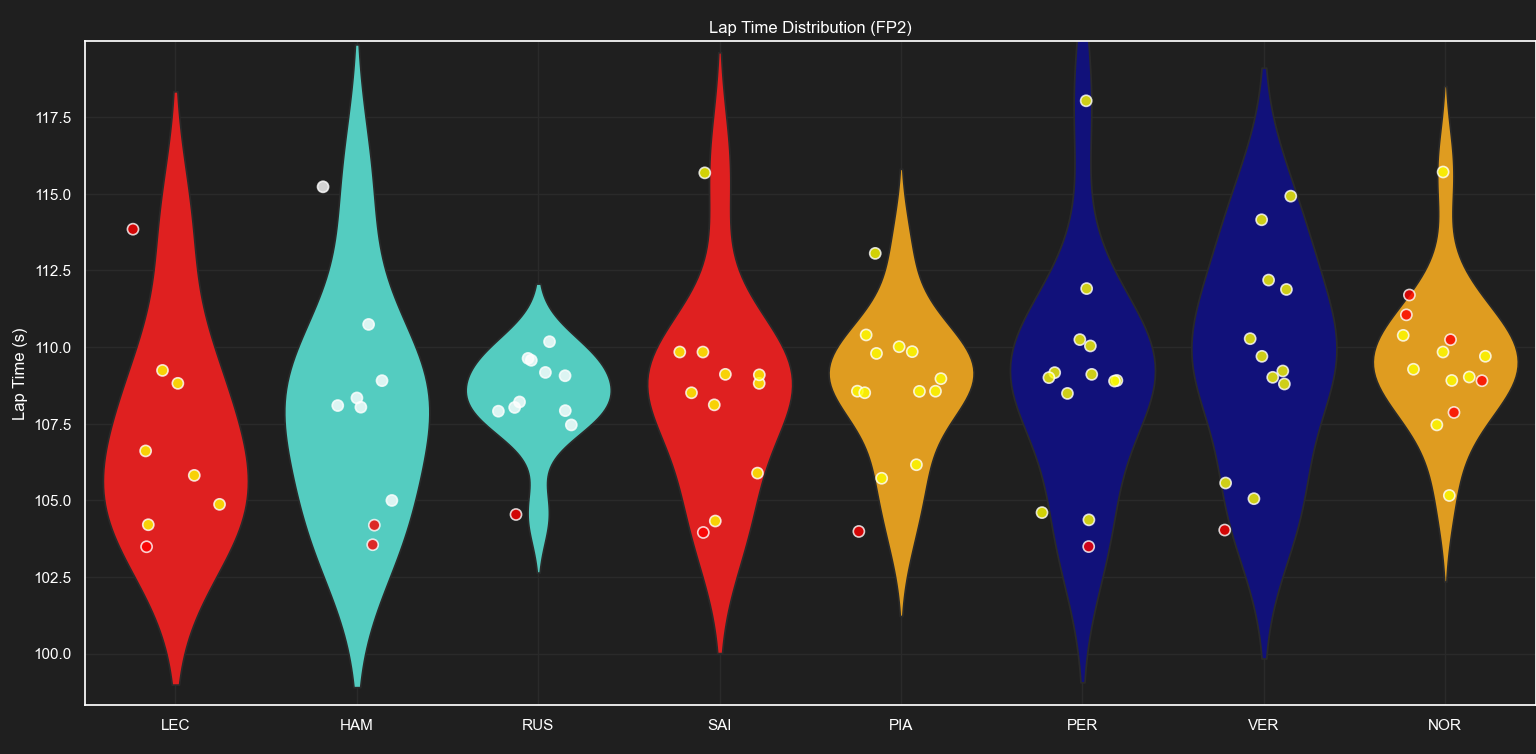
The Mercedes is the only one to make long runs on the Hard, while the rest has focused on the medium. Russell’s W15 and the two McLaren’s by Piastri and Norris have recorded a more consistent long run than the others:
Perez: 1:49,22 s/lap (M, long run of 8L, start age 8L)
Sainz: 1:49.04 s/lap (M, long run of 7L, start age 7L)
Piastri: 1:49,24 s/lap (M, long run of 9L, start age 6L)
Russell: 1:48.71 s/lap (H, long run of 10L, start age 0L)
Norris: 1:49.51 s/lap (M, long run of 6L, start age 6L)
Norris: 1:50,47 s/lap (S, long run of 4L, start age 4L)
Hamilton: 1:48.34 s/lap (H, long run of 4L, start age 0L)
Verstappen: 1:50,14 s/lap (M, long run of 7L, start age 6L)
Leclerc only recorded a step with the medium of 3L, very inconsistent, so I do not consider it.
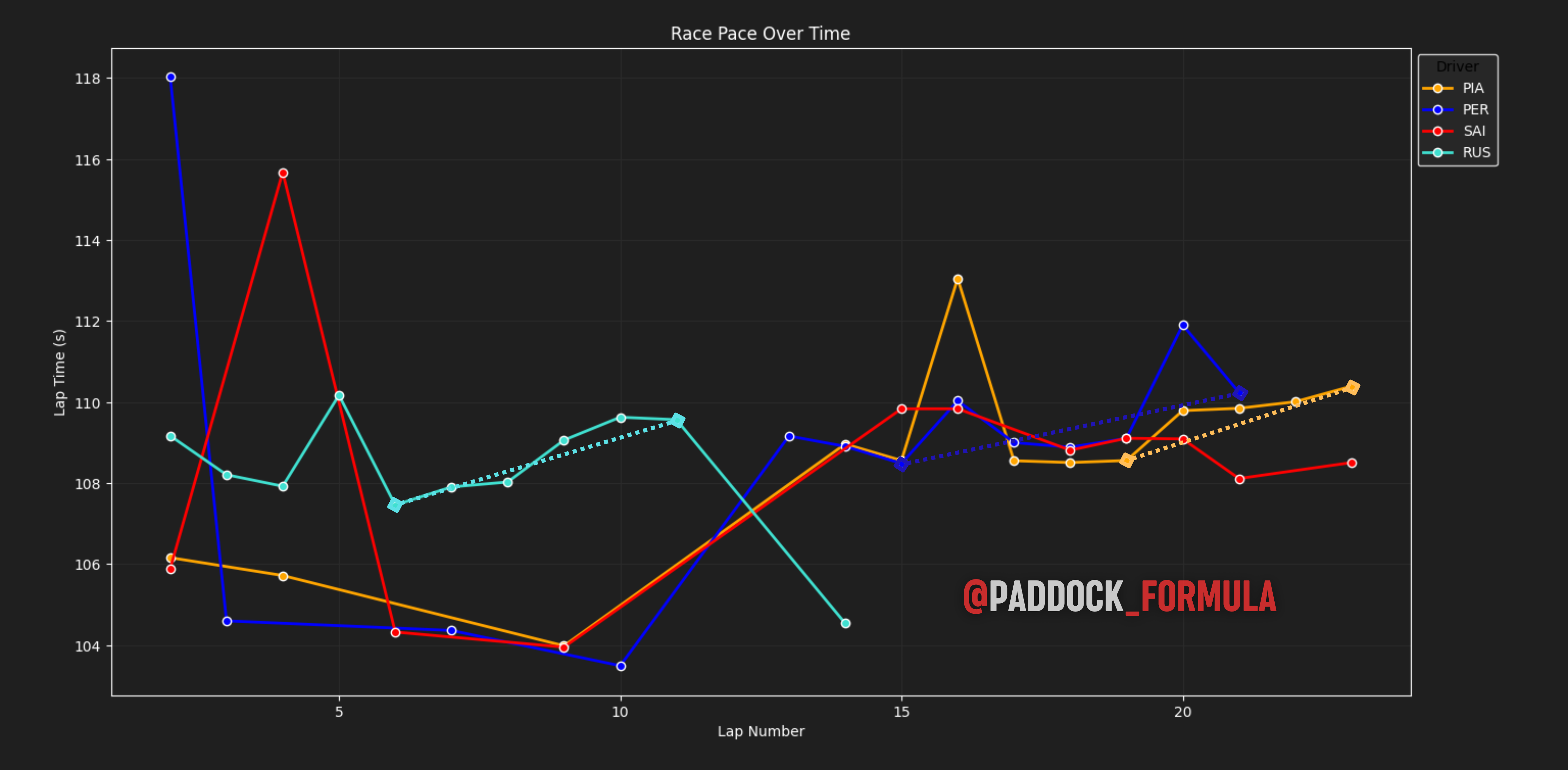
In FP2 the McLaren of Piastri suffered a strong degradation towards the end of the stint, remember that he started the long run with a medium who already had 6L, then the degradation occurred after the 12th laps, this could create some doubt in the team McLaren. In particular Piastri via radio communication says that the front tires have suffered a high degradation, very strange considering that it is a circuit that puts more stress on the rear tyres.
Piastri during the session suffered from some balance problems such as understeer, requiring some adjustments to the front wing adjustment, to increase its load and try to reduce it.
Leclerc had serious balance problems because after the accident in FP1 the car was not in perfect condition, forcing him to return to the box and change the steering box. He then returns to the track and records the best lap with a lead of 6 thousandths over Perez, we also have to consider the evolution of the track, but it is still a good signal for the team.
QUALIFICATION SIMULATION
We compare the top three fastest, namely: Leclerc, Perez and Hamilton. We have three drivers from three different teams, so we can compare the various strengths and weaknesses of the different teams. As mentioned above, Leclerc had to delay his qualifying simulation because of a gearbox replacement, finding favourable conditions. Let us analyse the qualification simulation together:
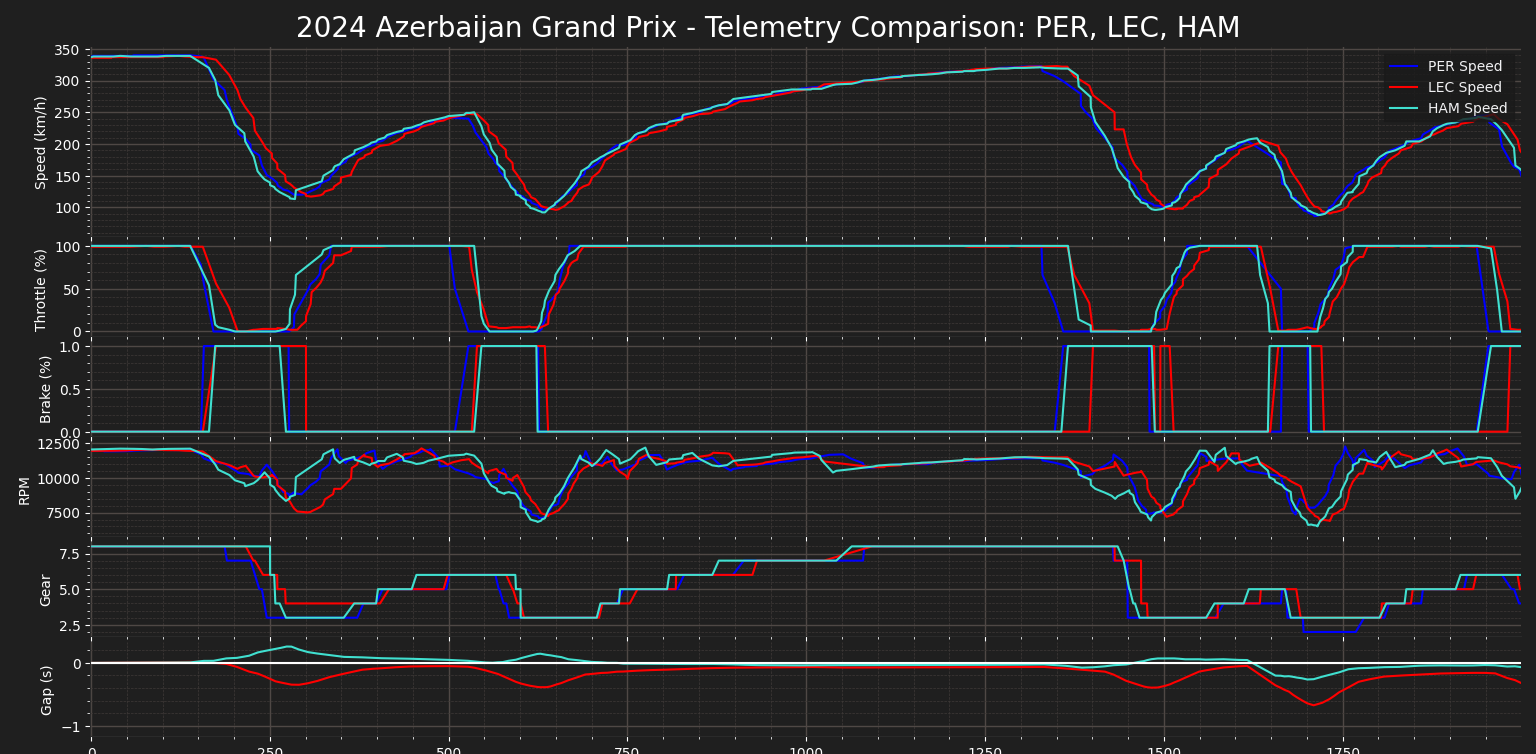
At first glance, we notice a Ferrari that tends to favor entry speed (if you have seen the analysis on the qualification of 2023, the strategy was opposite, optimizing the traction in exit).
The first to slow down and brake is Perez, who arrives at the braking of turn 1 at a speed of 340 km/h, the difference is not much, immediately behind there is Hamilton with 339 km/h and Leclerc with 338 km/h. Perez shortly after having lifted the foot from the accelerator brakes with decision, the same Hamilton but does it later, while Leclerc brakes and raises the brake progressively, bringing more speed in entry.
The Ferrari driver, unlike the other two, takes on Turn 1 in fourth gear, while Hamilton and Perez are in third. This does not optimize traction, however, and it is in fact the worst speed on the way out. is the British of the Mercedes to have the best traction, arriving at curve 2 with 244 km/h, 2 more to the Mexican and to Leclerc.
The story repeats itself, Charles brings again more speed in entry, Perez is again the first to slow down, while Hamilton starts braking after Leclerc and for less time, and manages to have a traction equal to Perez, arriving at turn three with a speed of 320 km/ h, 3 less than number 11 and 2 less than number 16.
As last year, during the cornering of turn 3 Leclerc uses twice the brake. At turn 4 the RB19 driver faces the curve in II gear unlike Hamilton and Charles, who face it in III.
Coming in turn 5 the first sector ends and is in front of the Monegasque Scuderia Ferrari.
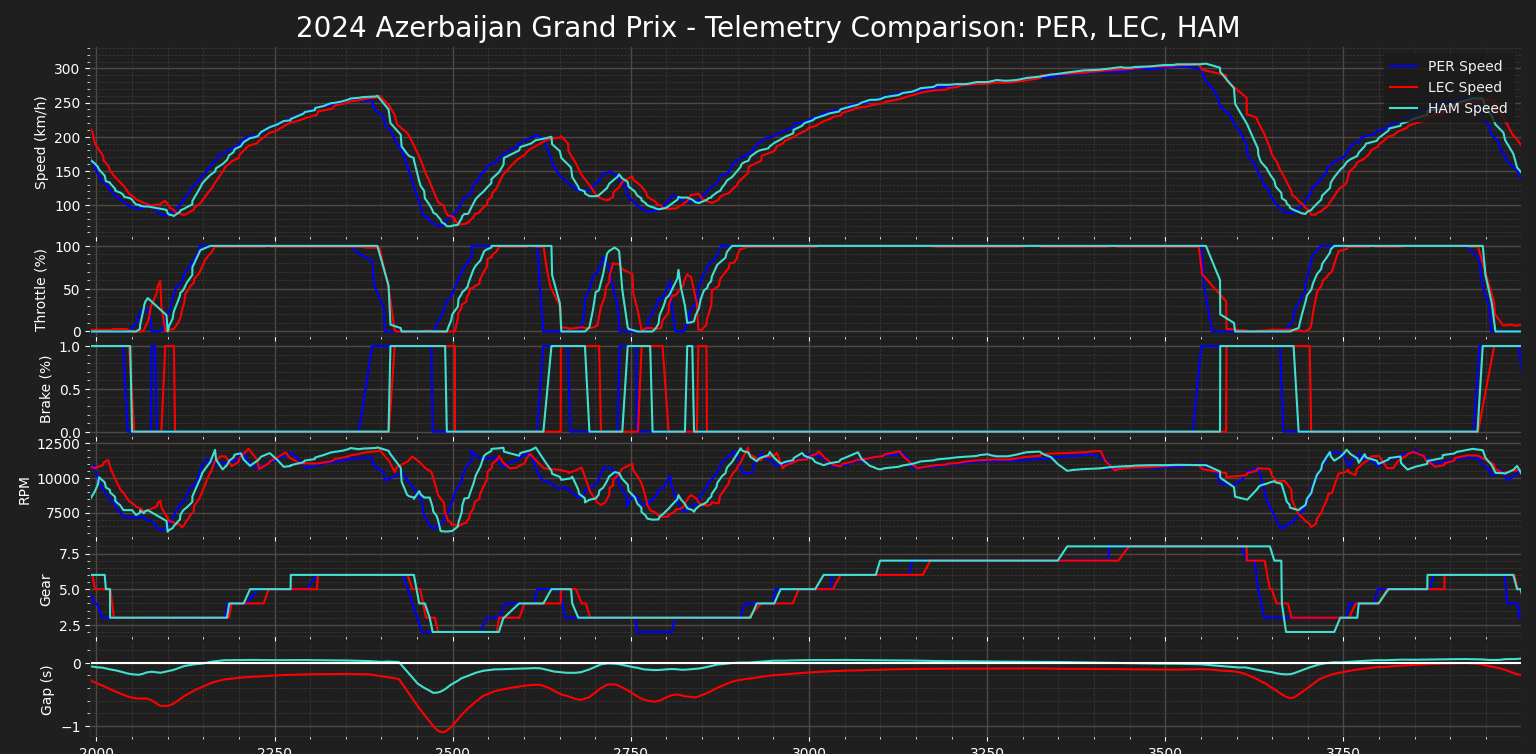
Leclerc is not untrue in the second sector either, favoring speed in and out. Arrived at the chicane of turns 5 and 6, when Perez and Leclerc on are entering for turn 6, both braking, Leclerc when the Mexican started to brake he started to accelerate, but then soon after it’s his turn to brake. Hamilton was the only one not to face during the change of direction between turn 5 and 6.
After the 7th turn comes the most complex part of the circuit, also here Perez raises his foot from the throttle and brakes first and in turn 11 he faces the curve with one gear less. But this allows him not to brake in turn 12, as Charles and Lewis do instead and brings greater speed on the exit, which leads to a sequence of turns that form a straight line ending in turn 15.
At turn 15, Perez recorded an EOSS of 301 km/h, while the car no. 16 and 44, registered a speed of 305 km/h and 306 km/h respectively.
This time to face the curve with one gear less was Hamilton trying to optimize the exit phase, but he fails and at the moment Perez has a slight advantage over the British.
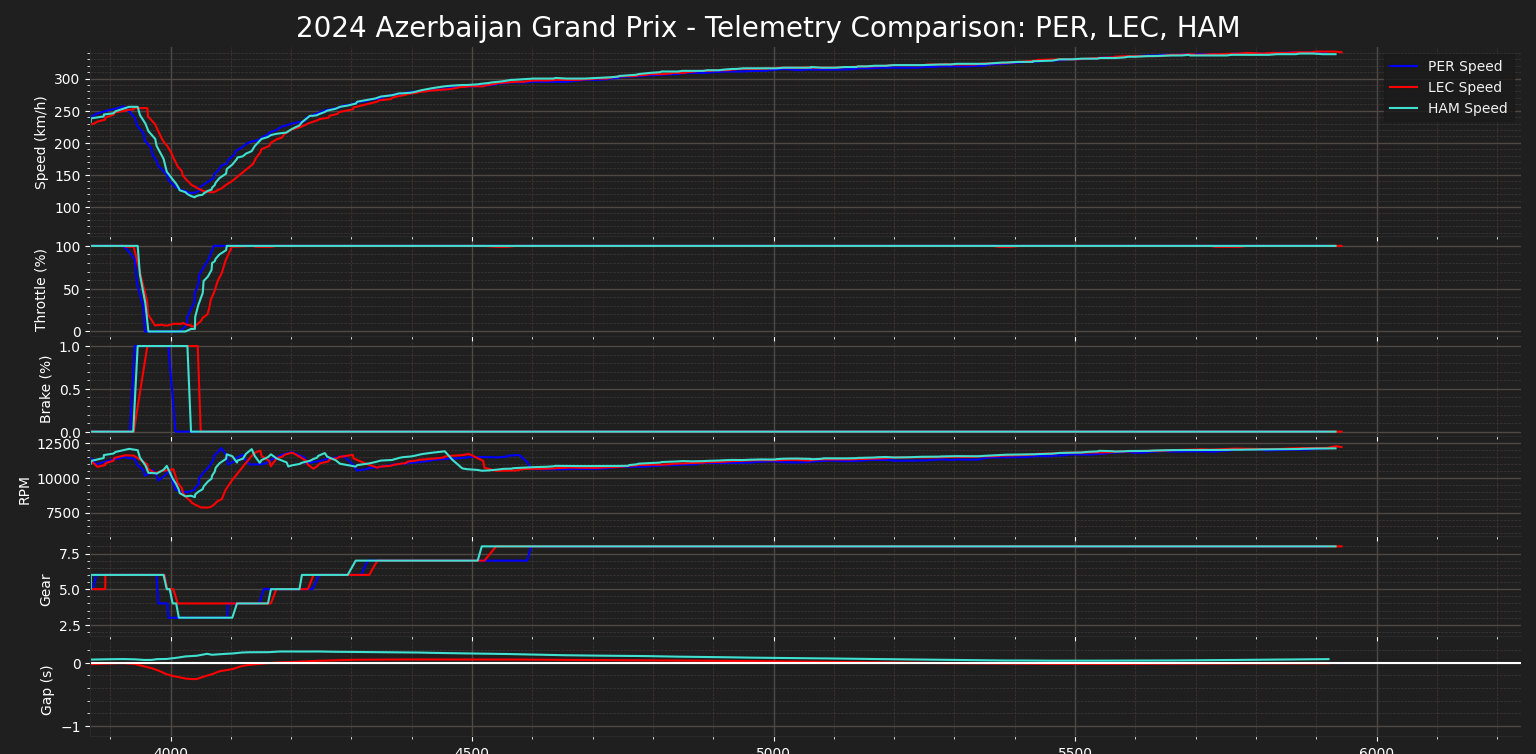
Even in turn 16 the Red Bull of the Mexican sacrifices speed in entry but slightly slower than the 7 times world champion. Both face the curve climbing to III gear, while Leclerc in IV and does not raise the foot of the accelerator, starts braking at the same time as the other two, but gets to press it completely progressively, Ensuring that you can bring more speed in.
But it is Sergio who has the best, reducing the gap from Leclerc and increasing the advantage he has over Hamilton, they arrive at the finish line with a speed of 342 km/h for the driver of Ferrari, 341 km/h for Perez and 338 km/h for Lewis.
If it had been the real qualifying, Leclerc would have got pole for only 0.006s over Perez.
From this qualifying simulation we can understand some things: the Ferrari has changed the way of managing the ERS, favoring the EOSS and no longer the output traction as it did previously. Red Bull, which until now preferred to optimize the speed of entry, now prefers to sacrifice it and favor the speed of exit, perhaps because of the new floor? Mercedes seems to have been the compromise between these two teams, but as Hamilton complained in FP1, the W15 did a lot of work in T2.
If you like my content follow me here (it’s free) and also on the other social networks, while if you want to support my project, I would be very happy, but don’t feel obliged to do so!
Commenti
Posta un commento