CONDITION:
Track temperature: 39,5 °C in Q1 ---> 36,5°C in Q3
Air temperature: about 28,8°C
Humidity: 39%
Wind: 16,5 km/h in Q2 --> 10 km/h S
Qualifying for tomorrow’s grid is over, and not in the best way for Mercedes, with Russell losing control of his W15 on turn 19, forcing him to go into the wall, and finish qualifying before the other drivers could finish their last stint.
Thanks to Lando Norris, who finishes on pole, while in second place there is his main rival Max Verstappen. Let’s go to the fastest lap of the WDC contenders.
LAP ANALYSIS:
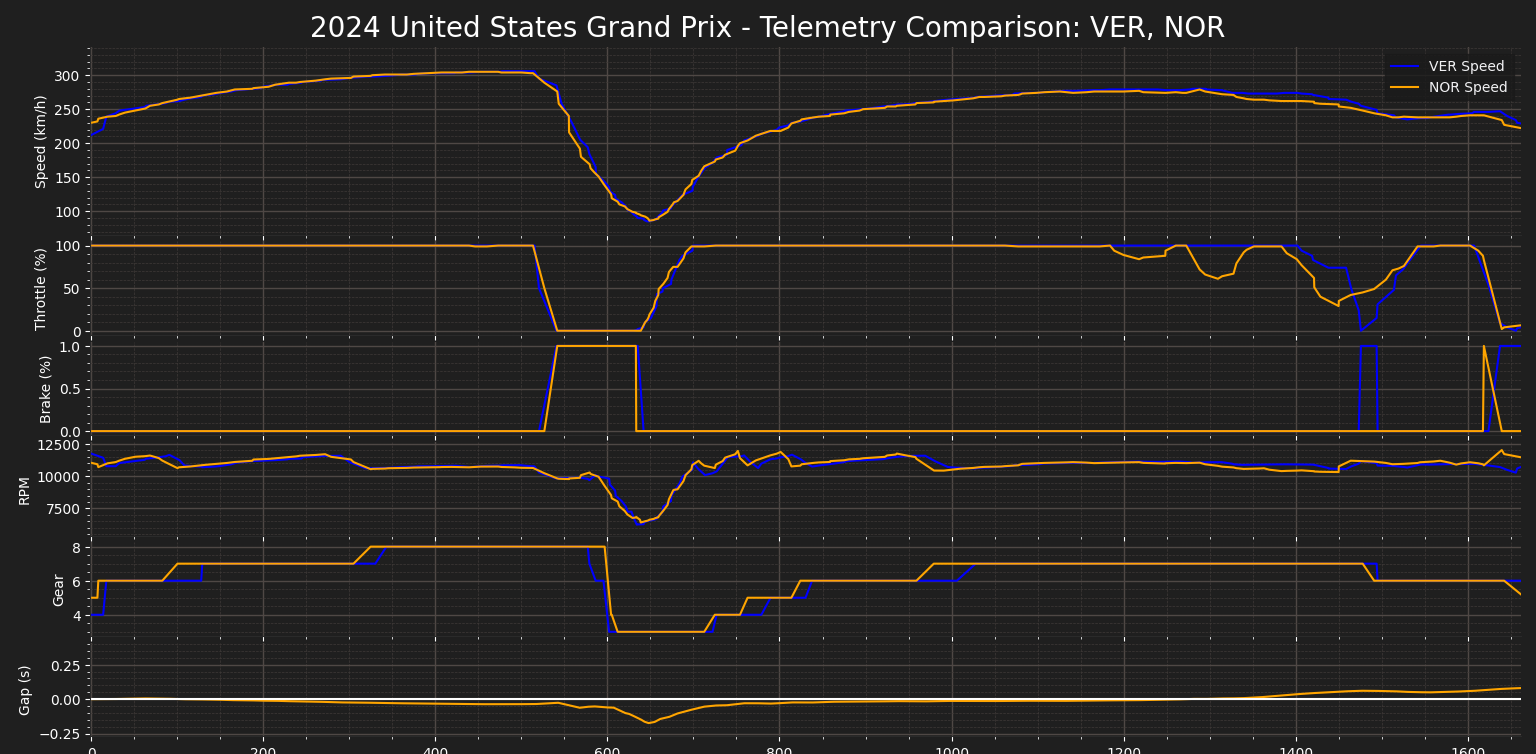
We start immediately with the first turn. Verstappen stops slightly earlier than Norris, but manages to bring in a little more speed than Lando Norris, the driver of the Red Bull manages to create an advantage that is immediately reduced in the exit phase. In which it would seem that the driver of the McLaren has the better, in fact observing the gears, manages to pass to the next before the rival.
We arrive at the "snake" and it must be immediately highlighted that until turn 6 Verstappen does not raise the accelerator, while Norris is forced to do so, the reasons can be two: the first is for the setup, it seems that the Austrian team has preferred a more rigid setup, which allows him to have a more stable floor than the McLaren, which instead seems to have a softer setup to be faster in the third sector. Or, (the second reason) they preferred to sacrifice T1 not to heat too much the tyres.
Bringing lower speed in turn 6, Norris is not as forced as the Dutch to brake in the entry phase, and not to lift his foot completely from the accelerator.
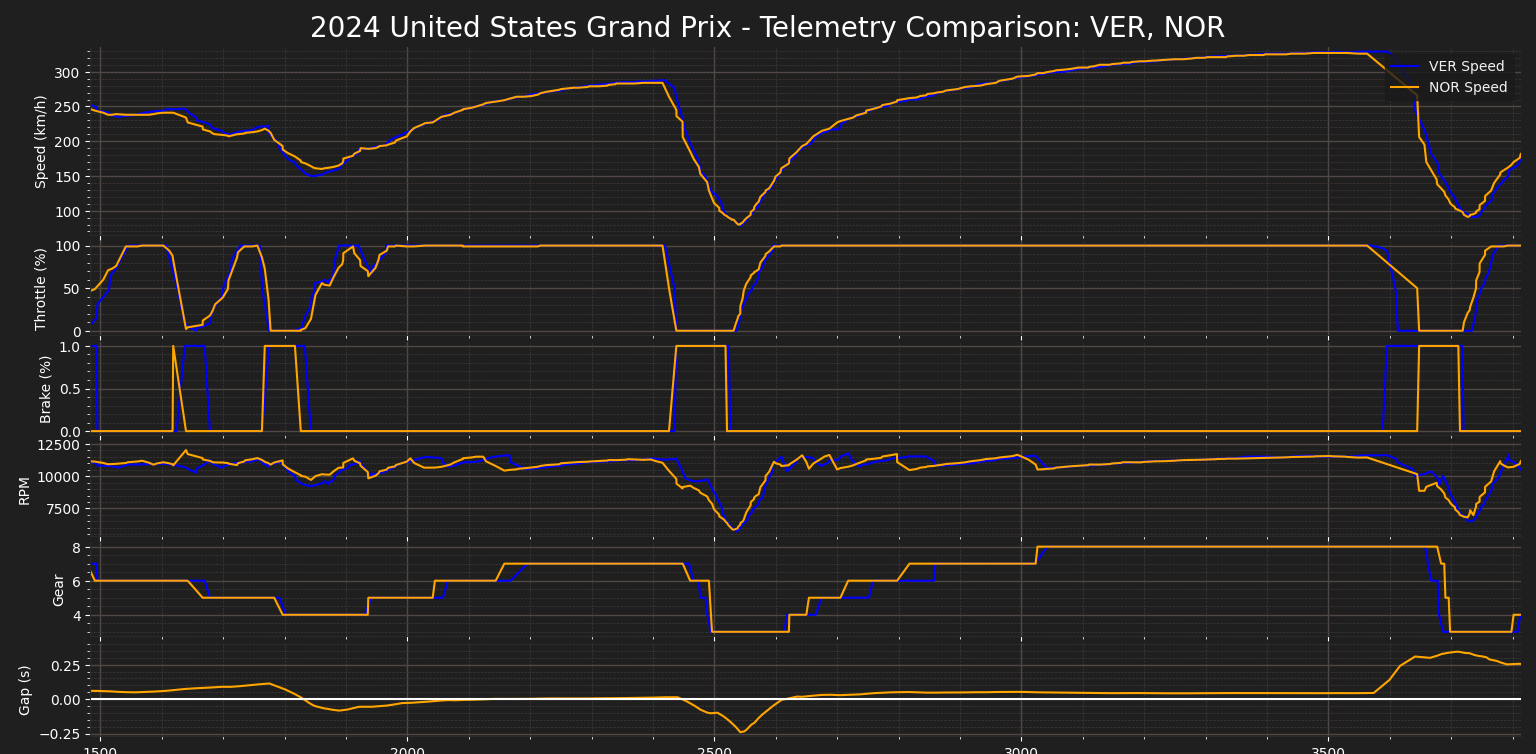
From Turn 7 starts sector 2, characterized by few curves but two very long straight lines, where it is very important to have a good aerodynamic efficiency.
However, in turn 7 there is a situation similar to that of turn 6, in fact Verstappen enters with a higher speed of the driver in second position in the WDC, this forces him to have to brake for longer, while his rival does not need it and only touches the brake pedal for a moment.
This allows the car 4 to have a small momentary advantage, but in the exit phase the champion in charge manages to reduce this gap. In curve 8-9 we notice that Lando manages to have a better distance, in fact the orange line for all curve 8 manages to have a better speed (161 km/h Norris, 150 km/h Verstappen).
After turn 9, in which Lando seems to have come out better, getting a higher speed at the beginning of the straight, but this does not remain the same even for the end, in fact Verstappen has an EOSS of 287 km/h against 284.
In turn 11, again, Verstappen brings greater speed on the input, at the expense of the output, In fact when both reach 100% throttle, Norris has a speed of 155 km/h against 139 km/h of the driver of the Red Bull.
However, at the end of the straight, McLaren loses that advantage in terms of speed, in fact the EOSS of Max is 329 km/h against 326 of Norris.
"In turn 12, the advantage of car 1 begins to be created: the British lifts his foot from the accelerator gradually, which allows him not to use the brake for too long, unlike the rival who has instead approached the curve in a completely different way."
This also allows him to align the wheels first and be able to reach 100% of the throttle, in fact when both are on the straight and Verstappen reaches 100% of the throttle, the British is at a speed of 136 km/h, against 166 km/h of Norris, a difference of 30 km/h.
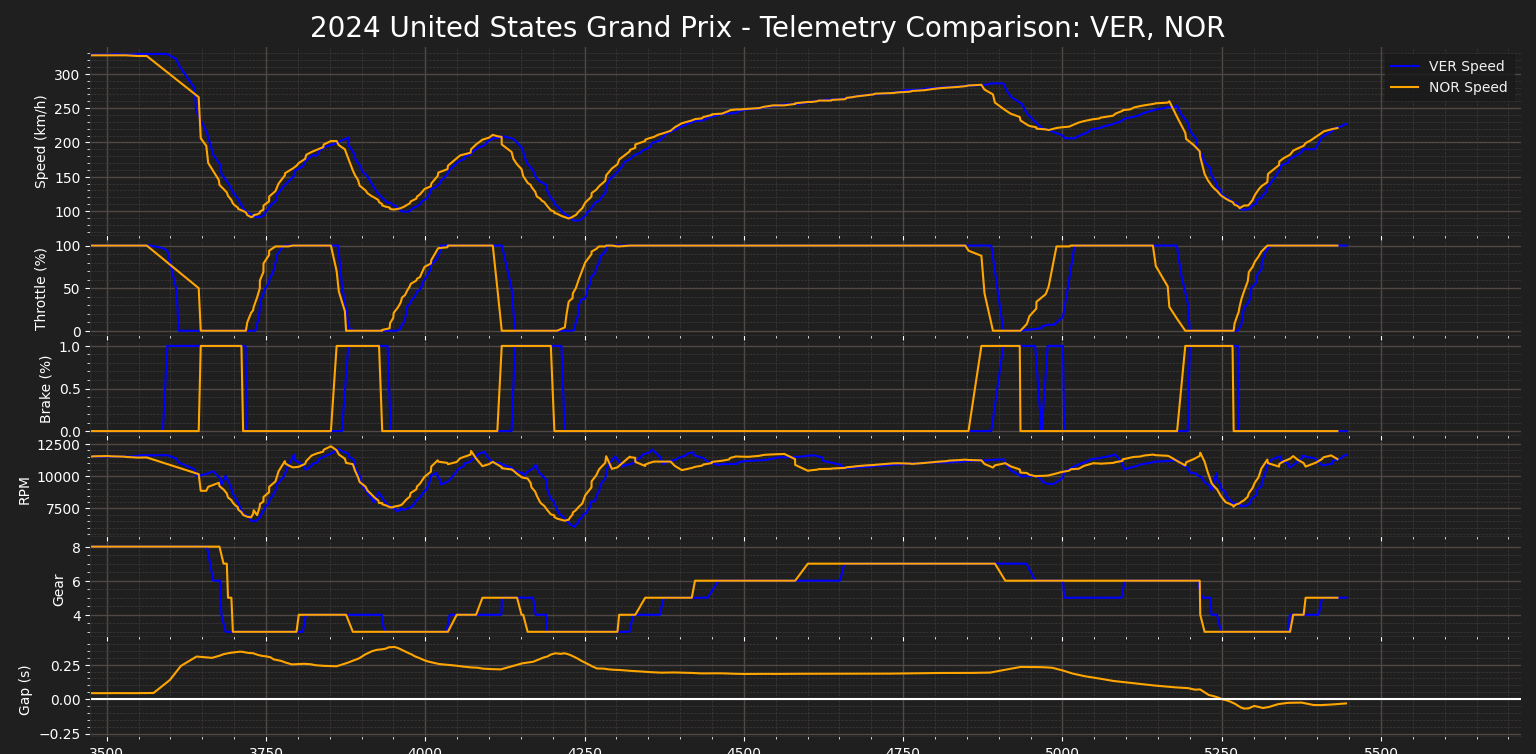
This choice to sacrifice the entry to be able to have a better exit instead (may not be a choice of the pilot, but perhaps the McL38 is more understeering than oversteering, and therefore prefer to exploit the potential in output) It does not seem to pay back, in fact we notice that before the turn 16, the orange line in the entry phase has a lower speed than that of the Dutch, and on the contrary, greater speed in the exit.
We notice that in these curves the poleman slows and brakes much earlier than the driver of car #1. But this allows him to have a lot of speed in the entry phase and in the run-up to turn 16, where he manages to reduce his distance from Verstappen.
The difference that allowed Norris to make the pole will be seen in these last curves: at the entry phase for the turn 19, we notice the usual behavior of the British with his McL38, slows down and brakes much earlier and will be the first to reach 100% of the throttle.
In turn 19, the defending champion seems to make a mistake, he is forced to brake again and to scale one gear, delaying much the arrival of 100% throttle. In fact, when both arrive at this value, Norris has a speed of 231 km/h against the 206 km/h of Verstappen, a difference of 25 km/h.
This allows the British team driver to recover more than one tenth of the Dutch. In turn 20 and last turn of the COTA circuit, Lando slows down progressively but not so much brake earlier than Verstappen, this allows him to lift his foot from the brake first and be able to press the accelerator, Thus, it can have an exit speed of more than 35 km/h and on the finish line of 20 km/h, gaining again more than one tenth and being able to get the pole of the 2024 edition of the USGP for only 0.031s.
If you like my content follow me here (it’s free) and also on the other social networks, while if you want to support my project, I would be very happy, but don’t feel obliged to do so!
Commenti
Posta un commento