Let’s go back to a year ago to review the lap that allowed Leclerc to take pole position in front of Max Verstappen’s RB19.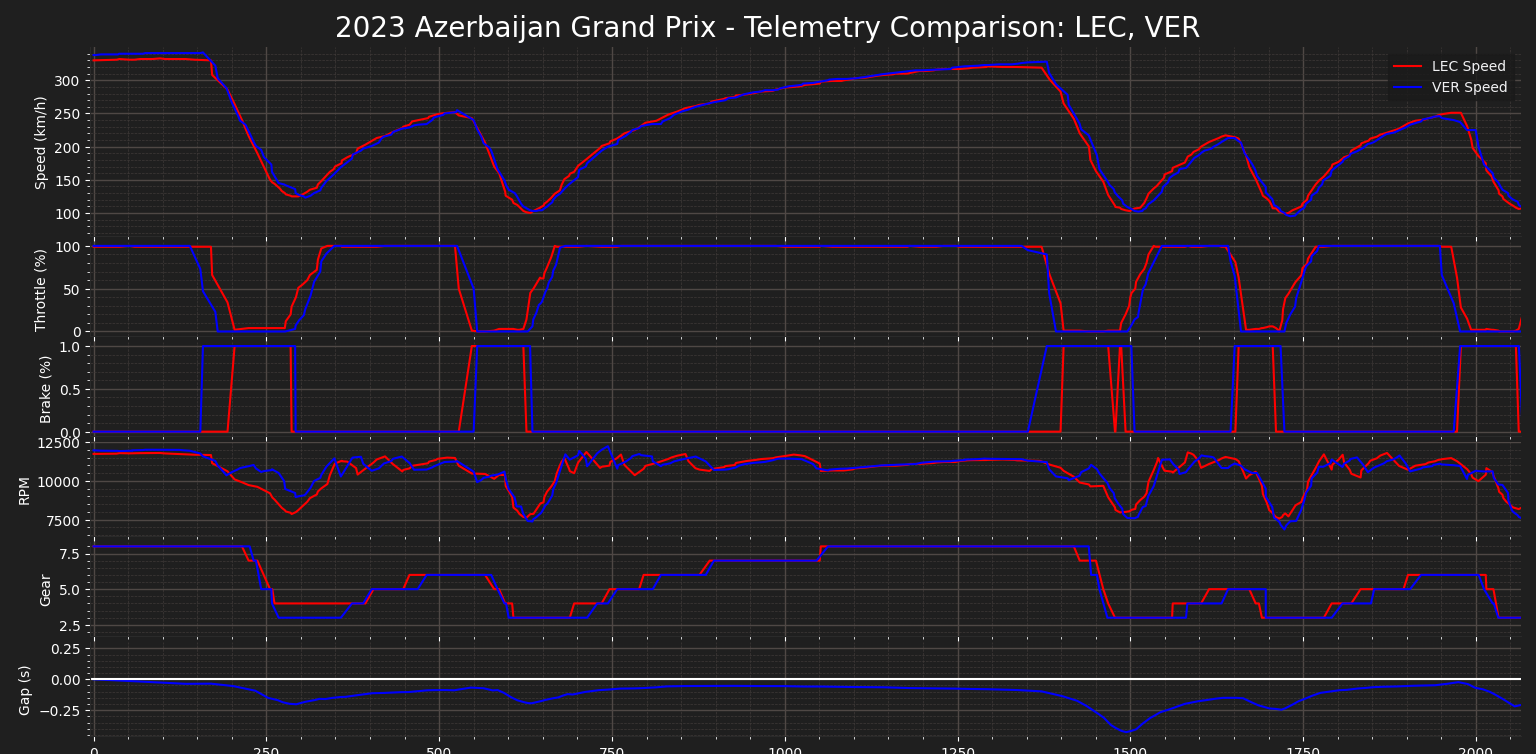
We arrive at turn 1, Max reaches a speed of 341 km/h, Charles instead arrives at a speed of 332 before lifting his foot off the accelerator and then braking. The Dutchman is the first to slow down and brake, while the Ferrari driver delays the braking, facing the corner in fourth gear, unlike the champion of Red Bull who faces turn 1 in third gear.
In the entry phase, the RB19 with number 1 brings more speed, starting to gain a little bit, but the Monegasque manages to reduce the gap slightly on the straight following an early restart, when Verstappen has the full-throttle is at 159 km/h while Leclerc at 170, a difference of 11 km/h. They finish the straight that leads to turn 2 with the same speed, 252 km/h.
This time it is the driver with the number to anticipate the braking and optimize the traction in exit, being able to pass first to the fourth gear. But he does not get a better EOSS, in fact at the end of the straight the Dutch has a lead of 6 km/h compared to the driver of the Ferrari.
The rest of the curves in the first sector are very similar to the previous ones, Leclerc with his SF23 optimizes traction at the expense of entry speed. One curious thing, is that in the exit phase presses quickly the brake, probably to check a possible oversteer.
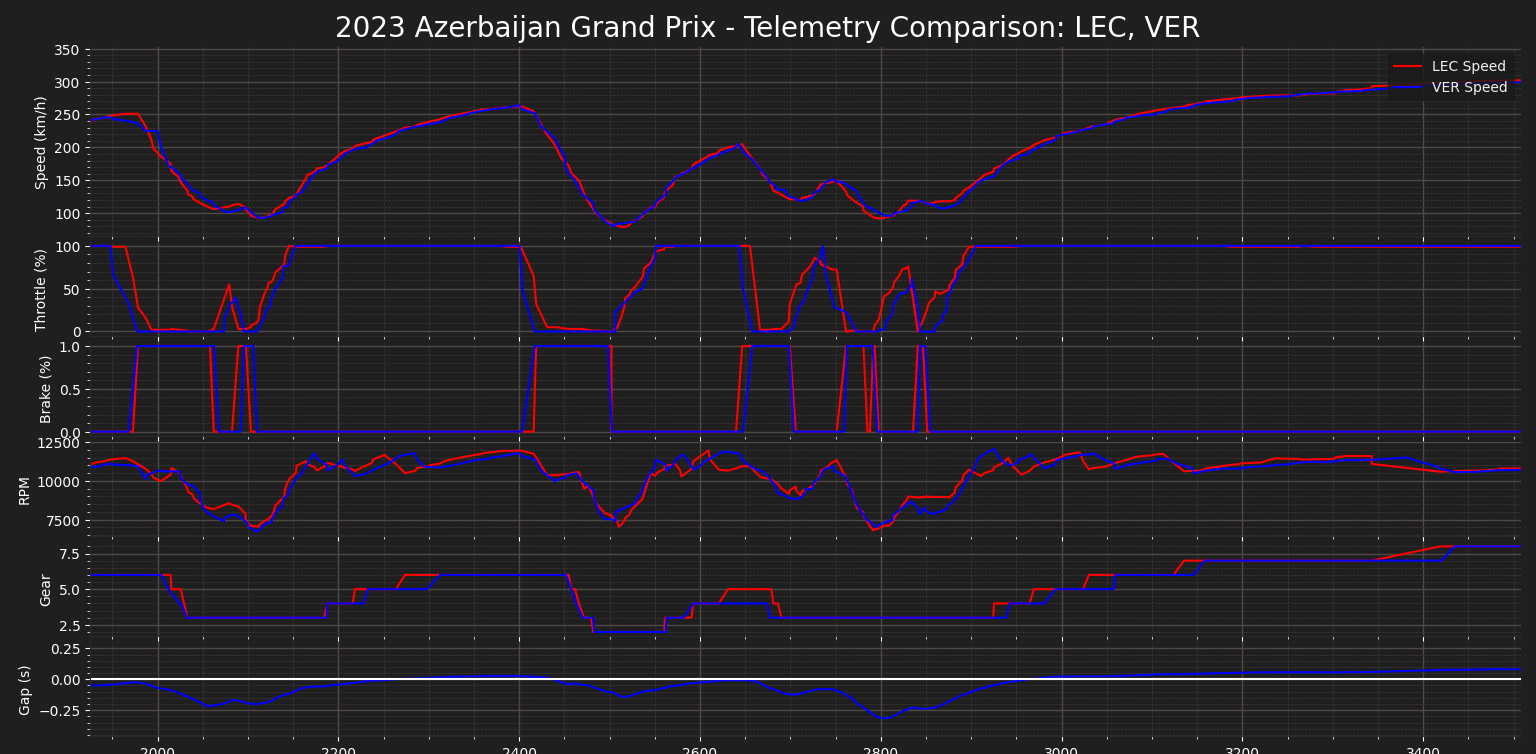
With the entry in turn 5 we enter the second sector. We are waiting for a chicane (curve 5 and curve 6), also in this case Leclerc tends to optimize the exit at the expense of the speed in.
Leclerc always takes the same way also curve 8-9-10-11-12, and this allows him to reduce the gap from Max Verstappen, then start to create a gap from the Dutch: in particular, in this sequence of curves Leclerc has never kept the throttle at 100%, This did not allow him to have a good entry, but not even a great exit, until he arrives at turn 12.
The Monegasque brakes for a surface similar to that of Verstappen, but he anticipates the braking, and only raises the accelerator for a few moments, then gradually reaching 100% of the throttle, this much before Verstappen, Making it appear that on the telemetry there was no curve 12 for Leclerc.
Leclerc in the entry phase records a speed of 118 km/h, while Verstappen only 108, with a difference of well 10 km/h in the entry phase, while in the exit phase, when both have reached 100% of the throttle, Charles is at 154 km/h, while Max at 142, a difference of 12 km/h.
Then there are several curves (eventually a kind of straight) that leads to strong braking in turn 15.
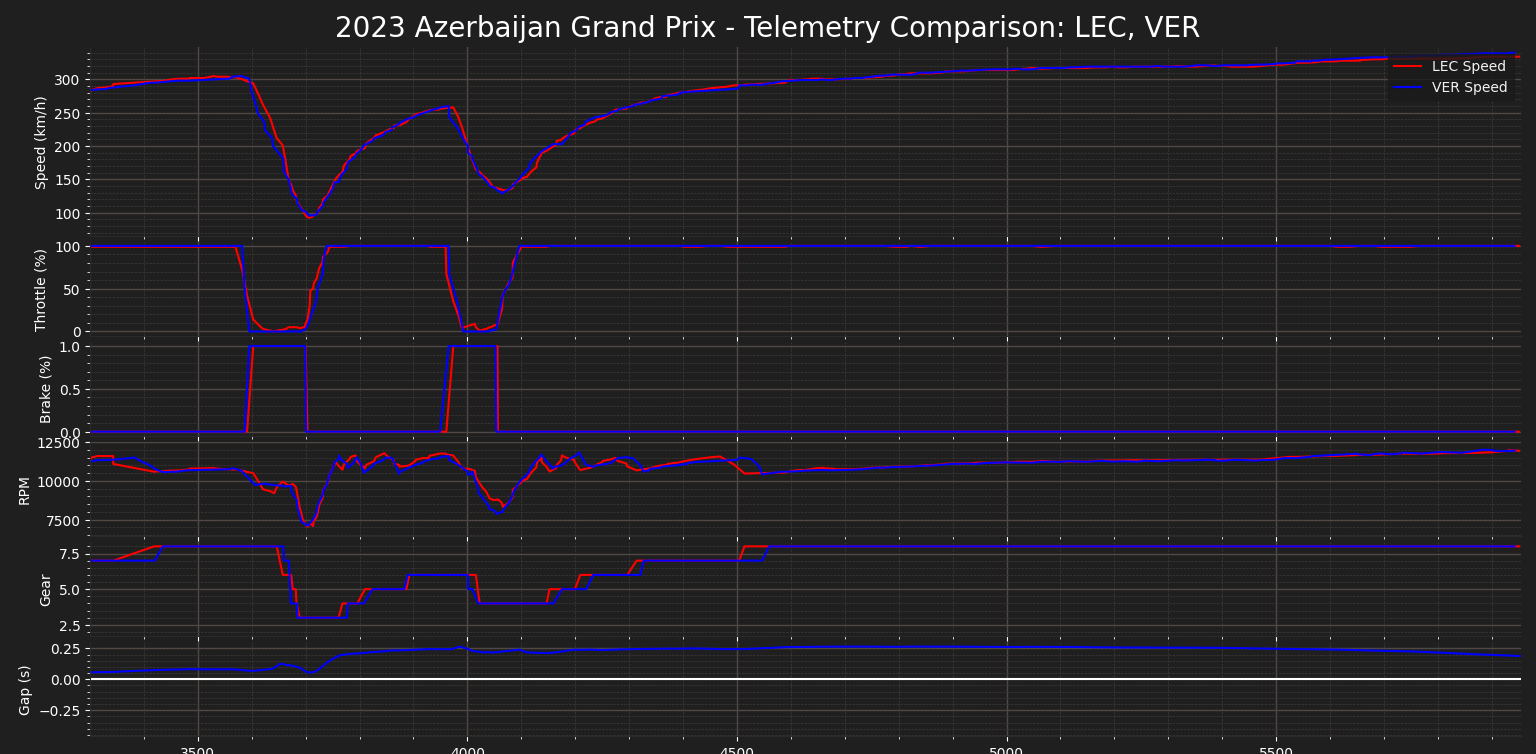
In this case Leclerc brings greater speed in the entry phase, gain a few milliseconds during this phase, towards the apex Verstappen gains some milliseconds again, but again Leclerc manages to start better, increasing the gap in the straight leading to curve 16.
The Monegasque first raises his foot from the accelerator to brake after Verstappen, you can also see by the late change from sixth to fourth gear, more directly than Max, the exit phase Leclerc manages to increase the speed before the Dutch, but does not bring them an advantage either in terms of speed or in terms of gap.
They then arrive at the finish line with a speed: Max 340 km/h; 334 km/h. The EOSS in Ferrari was not optimized, preferring to improve the exit phase. On the dry lap this worked.
So we could review a Ferrari that focuses on traction, as we have seen several times this year, which tends not to value the EOSS to prefer an advantage in the exit of the curve.
Follow me on social media to stay up to date, and if you like my articles support my project (always if you feel like it!): Instagram; X
Commenti
Posta un commento