RACE PACE ANALYSIS:
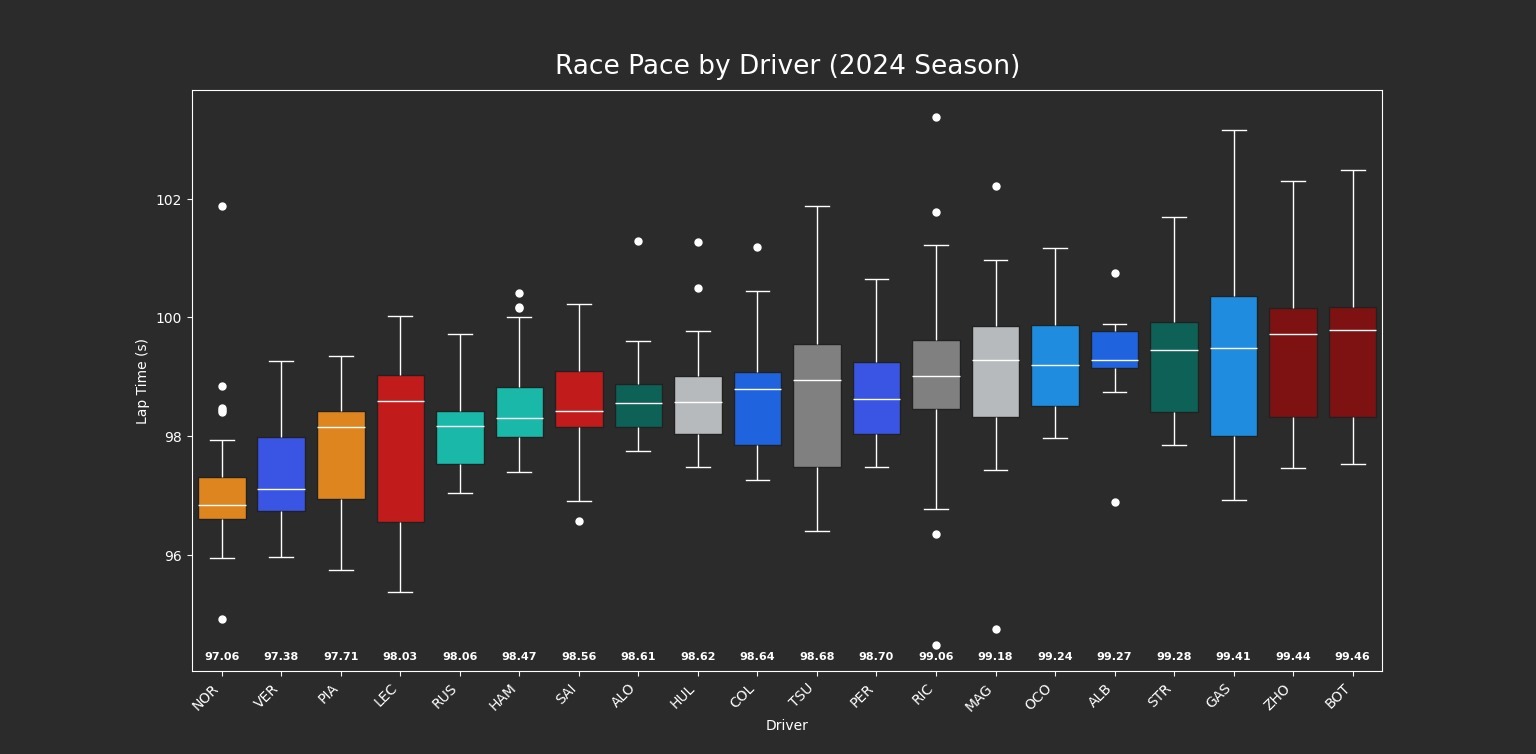
The fastest was race winner Lando Norris, with a 0.32s/lap advantage over his main WDC rival, Max Verstappen.
One thing we can notice immediately, is that unlike the previous races there are no similar steps, for example Piastri loses 0.33 s/ lap compared to the Dutch, and in turn Leclerc loses 0.32 compared to the Australian.
The most consistent was Norris, and this points to having a clear track ahead being very important in Singapore (so qualifying is very important). Just look at Leclerc, as the spread of lap times is very inconsistent and higher than driver #4, in fact the Monegasque driver in the first stint lost a lot of time behind Alonso.
Carlos Sainz is the second last of the top teams to have had a worse race pace, caused by a bad start, but also by an early pit (not being able to give the maximum at the end of the race). But he allowed him to make a fantastic undercut from 12th position to 6th ( and then leave it to his teammate.).
Perez had a bad qualifying, starting in the middle of the grid, for a long time in the first stint he was influenced by Colapinto. The difference between his teammate returns as before Monza, losing 1.42 s/ lap.
It is worth mentioning the performance of Alonso, Hulkenberg and Colapinto, all three had a similar step and better than Sergio Perez with a Red Bull.
For Sauber the situation continues not to improve, recording the race pace worse of the race.
STINT 1 ANALYSIS:
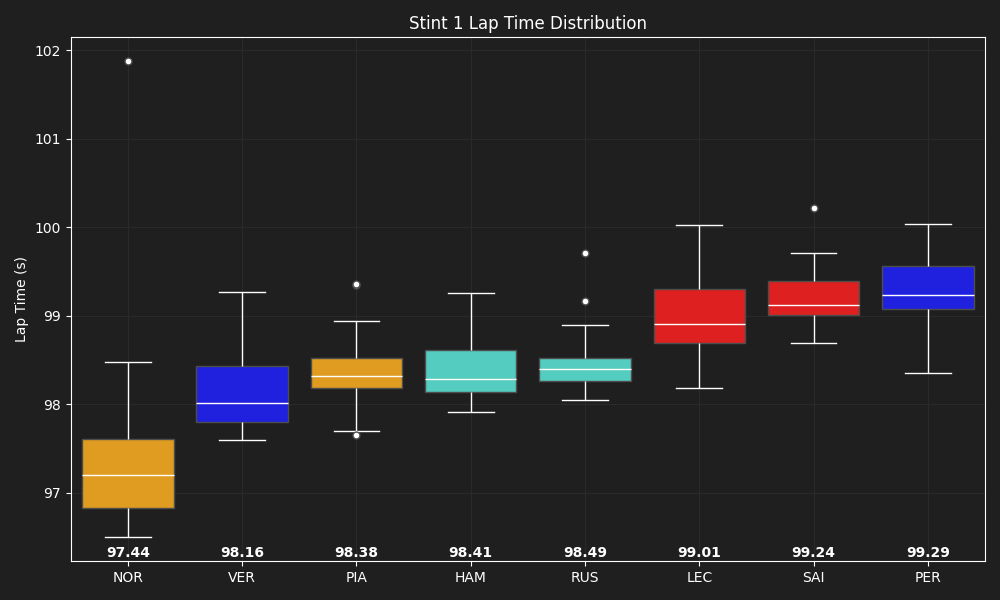
Norris is the fastest in the first stint and also the only one to go below 98 s/lap. Lando is faster than Verstappen by 0.72 s/lap, but less constant than the others, why?
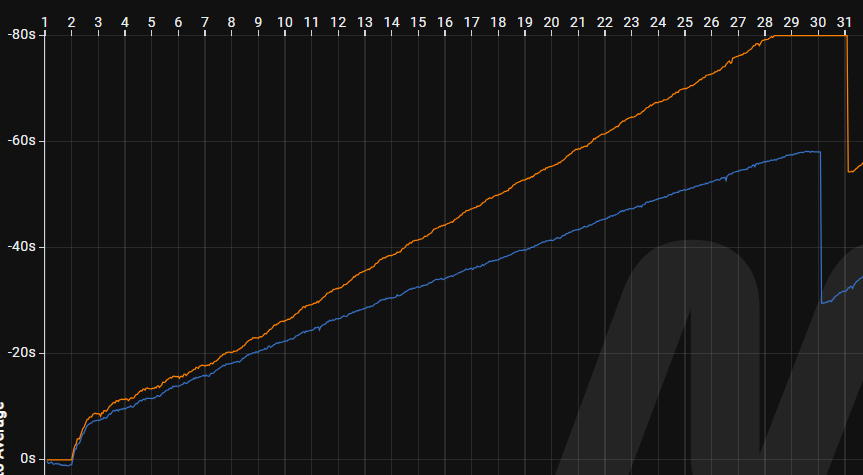
(Graph provided by multiviewer)
In the first laps and the final of the first stint, the British driver of McLaren records times ranging from 1:37 high and 1:38 low, the last particularly at the start of the race, where he had similar times to Max Verstappen, maintaining a gap not very important.
Towards the 8th lap, Lando receives a radio communication from the team, which invites him to go faster and create a minimum gap of 5/6s to neutralize any undercut from car #1. Norris obviously follows orders, recording a series of laps ranging from 1:36 to 1:37 low, monstrous times that only the driver of McLaren was able to do in the first stint.
Norris not only creates a 6s gap from Verstappen, but also creates such a gap that for a few more laps, he could have made a pit stop without waiting for Max to do it and get out of the pits before him (I remember that the pit stop in Singapore lasts 28s, and the gap that had Lando on the champion before he made the pit was about 22s).
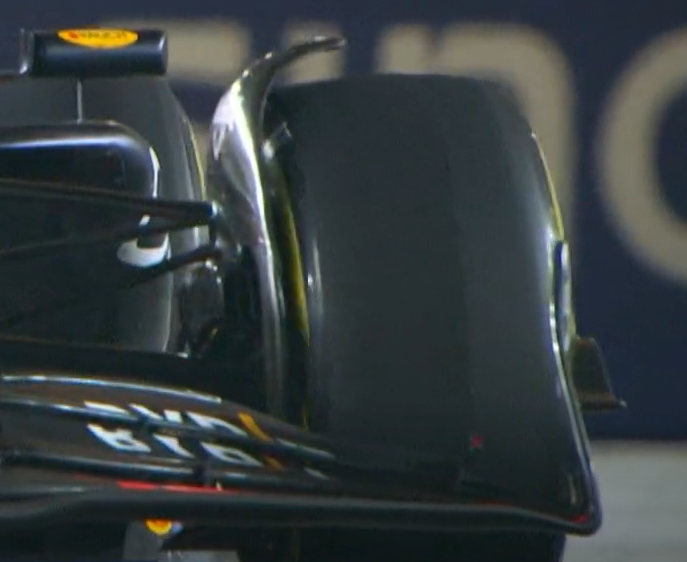
But Verstappen stops first due to more degradation of tyres and on the following lap Norris without problems performs his pit stop by riding the hard (as they do the others) and will continue his race undisturbed or better the only one who creates problems in his race is himself, risking to withdraw several times.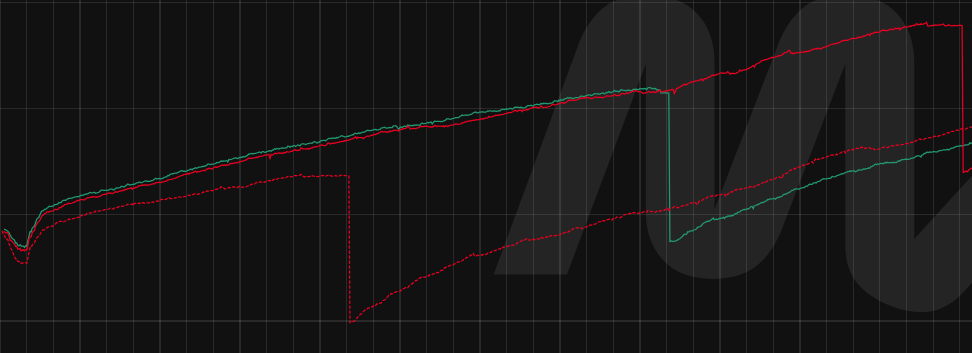
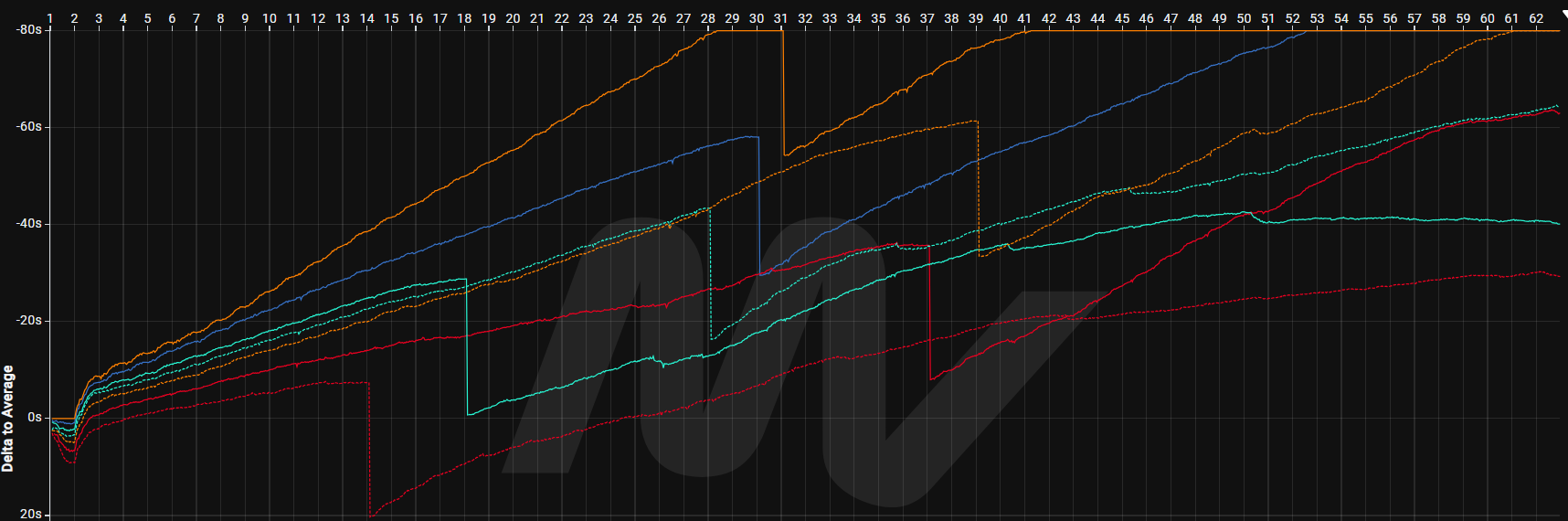
We move to 12th position, before the pit the Ferrari Spaniard was in this position (he loses two positions in the first lap). Sainz has a really slow pace, losing 0.75 s/lap compared to George Russell (to show how slow he was). The main reason? Traffic in Singapore is not easily overtaken, in fact, ahead was Perez with his RB20 who tried in every way to pass Colapinto with the FW46 (he will not be able to pass him on track). Therefore, Ferrari opts for a strong undercut on Alonso, making the pit at lap 14th (among the first to do so).
Strategy that works, in fact it works very well, Carlos after the pit stop has a lead over Fernando Alonso of about 5s.
Using this chart, we can also see why Leclerc had a bad step too, but for him it was not an undercut, but an overcut, extending the first stint until lap 37, one of the longest, (the longest was Piastri at lap 39). Why is that?
In my opinion, in the case of Leclerc, the undercut would only have led to taking the position on Alonso, without allowing him to have working tyres at the end of the race (as happened for Sainz and Hamilton), while the overcut worked very well because it allowed the (with better tyres) to catch up on Alonso and Sainz, and to be able to attack Hamilton and Russell (the latter did not succeed for a bit, we will talk about it in stint 2).
About Mercedes, the team risked a lot with the strategy for Hamilton, it was risky to start with soft and did not even pay off as hoped, inducing him to an early pit stop, forcing him to a final race in which his Hard tires were dead. Lewis should have had the better pace than the former (excluding Lando) but instead he lost 0.25 s/lap compared to Verstappen, 0.03 s/lap compared to Piastri and had a lead of only 0.08 s/lap compared to his team-mate.
STINT 2 ANALYSIS:
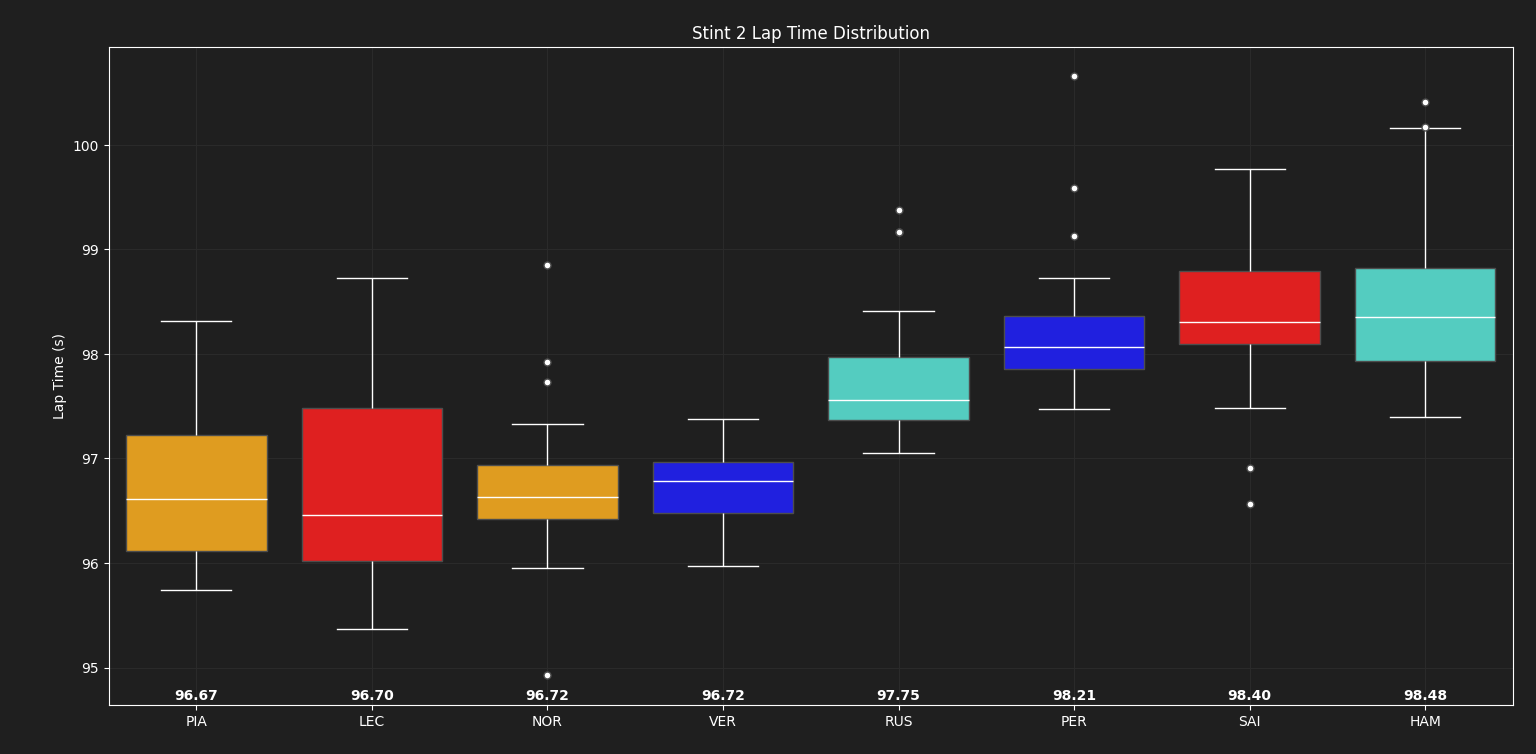
In the second stint we see a different scenario, in fact we see another faster McLaren, that of Oscar Piastri, after 0.03 s/ lap we find Charles Leclerc and immediately after we find Lando Norris, with an identical pace to that of Verstappen.
It is actually wrong to say identical, it is true both have a pitch of 96.72 s/lap, but if we go to see in detail, Verstappen has a median (central value) higher than that of Verstappen, Then the upper and lower moustache are slightly higher than those of Norris McLaren. They had a very similar pace, it’s true, but Lando seems to have been slightly faster.
Back to the first two, the times of Leclerc occupy a larger space in the chart than those of Piastri, this is explained by two reasons: the first are those fantastic laps on 35.5s (about these values) to reach rivals; the second, or those higher values, happened when he was in traffic and overtook Alonso, Sainz, Hamilton and try to overtake Russell.
While Piastri had only to overtake Hamilton (it doesn’t take long to do so) and then Russell, to have a clear track and therefore his pace is more constant than that of the monegasque.
Let’s go to the bottom of the chart and we notice that there are Sainz and Hamilton, with a respective pace of 98.40 s/lap and 98.48 s/lap, respectively slower than teammates of 1.7 s/lap and 0.73 s/lap. If we remember these two were the first to make the pit stop, with the difference that Sainz from that strategy gained 4 positions, while Lewis loses 3.
The problem is that even at the beginning stint the Hard have worked in the best way, both for Hamilton and Russell, complaining that he can not find the right window of operation, suffering a lack of grip, We also note a greater spread of higher times than Carlos Sainz.
As mentioned, the situation does not seem better for his compatriot, George Russell who in fact complains several times in radio communications with the oversteer and understeer team, really bad conditions, but that however towards the end of the race manages to defend itself from the Monegasque, with newer tires than his.
Charles in fact states that the British driver had more traction than him at the exit of the curves, this can be explained by various factors: perhaps Russell had more ERS capacity towards the end than Leclerc and exploit it more at the exit of the curve; George had kept the rear tyres; the driver of car n°63 has finally found the optimal window for the operation of the tyres.
Honestly with certainty I would not know to tell you, but I think it is more the first factor, Leclerc could have used the ERS to approach rivals in front of him, while George just waits for Charles to arrive, managing better the battery capacity, But again, this is only my guess.
If you like my content follow me here (it’s free) and also on the other social networks, while if you want to support my project, I would be very happy, but don’t feel obliged to do so!
Commenti
Posta un commento